
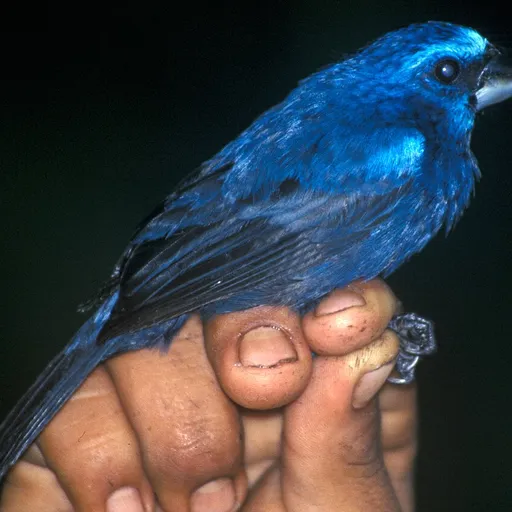
Blue-black Grosbeak
Cyanoloxia cyanoides
Least Concern
Listen
Overview
The blue-black grosbeak (Cyanoloxia cyanoides) is a species of songbird belonging to the family Cardinalidae. It is listed on the IUCN Red List as Least Concern and is found throughout Central and South America.
Identification
- Males possess dark blue plumage with lighter blue eyebrows, forehead, and shoulder patches, while females are dark brown with a slight reddish hue.
- The bird is often elusive, preferring to stay hidden within dense vegetation.
- Its song consists of approximately six whistles with decreasing pitch, ending with a distinctive "seee seee sewee suwee sweet suuu".
- A sharp "shek" or "chit" call is frequently repeated.
Habitat
Found in Belize, Colombia, Costa Rica, Ecuador, Guatemala, Honduras, Mexico, Nicaragua, Panama, Peru, and Venezuela, the species prefers habitats dense with tall trees and undergrowth that provide sufficient cover. It can also be found at the edges of broadleaf forests.
Diet
Omnivorous, the blue-black grosbeak feeds on seeds and fruits, as well as insects such as ants and caterpillars. It is known to crush seeds before consuming them.
Did you know?
In 2018, the eastern lowland population, previously classified as the subspecies Cyanoloxia cyanoides rothschildii, was split into a separate species known as the Amazonian grosbeak (Cyanoloxia rothschildii).
Sources
- Wikipedia · CC BY-SA 4.0
- Wikidata · CC0 1.0