
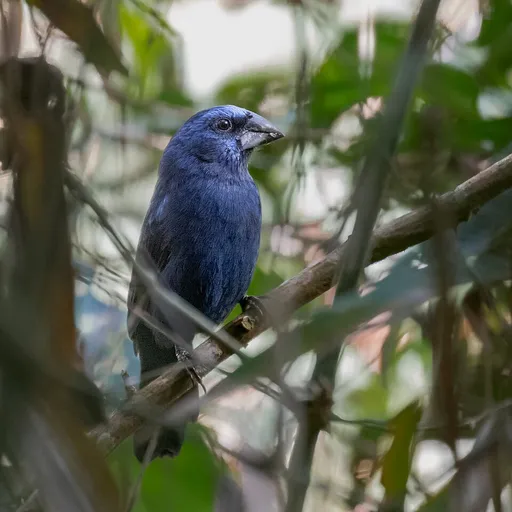
Amazonian Grosbeak
Cyanoloxia rothschildii
Least Concern
Listen
XC250739 · Niels Krabbe · Zamora-Chinchipe: Río Mayo, Ecuador · CC BY-SA 4.0
Overview
The Amazonian grosbeak, also known as Rothschild's grosbeak (Cyanoloxia rothschildii), is a species of grosbeak in the family Cardinalidae. It is the most widely distributed grosbeak in the Amazon Basin and is currently classified as Least Concern by the IUCN.
Identification
- Males are mostly dark blue with light blue forecrowns and parts of the wings, blackish bellies, and some black on the face.
- Females and juveniles have dark brown upperparts and paler brown underparts.
- Adults measure 14.5 to 15 cm in length and weigh between 21.5 and 31 g.
- The song is described as "pee tee-tu-tu-ti-pee'chee" while the call is a sharp, harsh, dry "tchit".
Habitat
Found throughout much of the Amazon Basin in Bolivia, Brazil, Colombia, French Guiana, Guyana, Peru, Suriname, and Venezuela. It inhabits the understory and edges of humid primary and tall secondary forests, ranging in elevation from near sea level up to 1,400 m in Peru.
Diet
Although little is known about its specific feeding behaviour, the Amazonian grosbeak appears to eat mostly seeds and fruit, with some insects as well.
Did you know?
Formerly considered a subspecies of the blue-black grosbeak (Cyanoloxia cyanoides), it was elevated to full species status following publications in 2014 and 2016. Its nest is a cup constructed from dried leaves and fern stems, typically holding a clutch of two eggs.
Sources
- Wikipedia · CC BY-SA 4.0
- Wikidata · CC0 1.0