
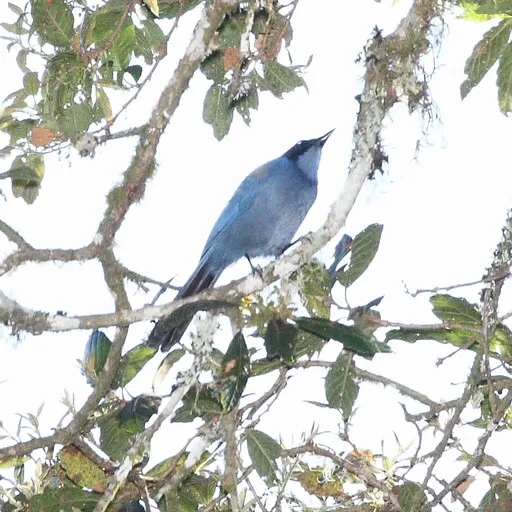
Dwarf Jay
Cyanolyca nanus
Near Threatened
Overview
The dwarf jay (Cyanolyca nanus) is the smallest bird in the family Corvidae, endemic to southeastern Mexico. It is currently classified as Near Threatened on the IUCN Red List.
Identification
- Measures 20 to 23 cm in length and weighs approximately 39 to 41.4 g, making it the smallest jay in the Americas.
- Adults feature a blue crown separated from a black facial mask by a thin, paler blue stripe, with grayish or violet-blue upperparts and grayish blue underparts.
- Possesses a black bill, black legs and feet, and a red-brown iris.
- Emits a limited vocal repertoire, including a nasal 'shree'up' in units of two or three, or a nasal 'shiev'a shiev'a'.
Habitat
Found intermittently in southwestern Veracruz, far eastern Puebla, and northern Oaxaca states in southeastern Mexico, the species primarily inhabits humid pine-oak forests in upper subtropical and temperate zones. It also occupies fir-dominated and secondary forests, showing a strong preference for areas with dense understory and subcanopy layers at elevations ranging roughly between 1,500 and 3,200 m.
Diet
Believed to be primarily insectivorous, the dwarf jay forages agily in the mid-story to lower canopy, seeking prey in vegetation, mosses, and bark crevices, and occasionally hovering or hanging upside-down. Foraging is typically done in pairs during the breeding season, but outside this period it joins mixed-species feeding flocks of up to about 20 individuals.
Did you know?
This diminutive corvid constructs its large nest entirely from moss and lichens, carefully lined with pine needles and thin rootlets, which are placed between three and 15 m above the ground, usually in the crown of a tree or at a branch end.
Sources
- Wikipedia · CC BY-SA 4.0
- Wikidata · CC0 1.0