
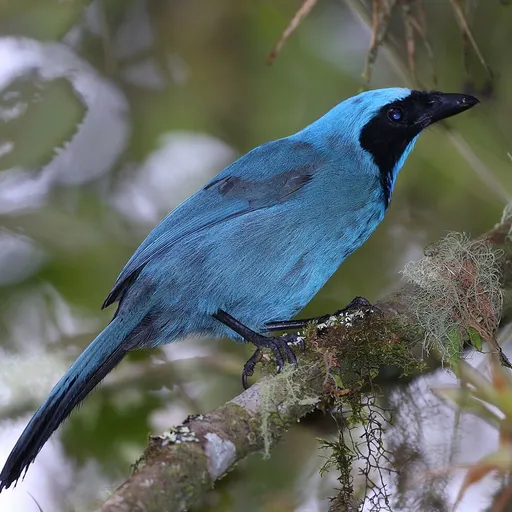
Turquoise Jay
Cyanolyca turcosa
Least Concern
Listen
XC250747 · Niels Krabbe · Zamora-Chinchipe: camp on Ventanilla-Christopher Parson trail, Reserva Tapichalaca, Ecuador · CC BY-SA 4.0
Overview
The turquoise jay (Cyanolyca turcosa) is a species of bird in the family Corvidae, found exclusively in South America. This nonmigratory species is classified as Least Concern on the IUCN Red List and is generally common within its geographic range.
Identification
- Vibrant blue-green plumage that can shift depending on lighting, with a very light, almost white forecrown.
- Thick black face mask extending to the auriculars and connecting to a thin black collar around the throat.
- Black underside to the wings and tail, with black legs, feet, and bill; brown irises.
- Primary vocalisation is a short, descending whistle, often heard in series, with a loud and slightly hissy tone.
Habitat
Native to the western Andes of southern Colombia, Ecuador, and northern Peru, the turquoise jay inhabits humid montane evergreen forests and elfin forests. It thrives in environments with dense, tangled trees and shrubs, often at elevations between 2000 and 3000 feet.
Diet
This omnivorous bird feeds on insects, berries, eggs, and the young of other species. It forages by exploring the midstory and canopy of trees, examining vegetation along the way.
Did you know?
The bird exhibits advanced social behaviour typical of corvids, with multiple individuals cooperating to build nests and care for the young. During incubation, the male specifically feeds and cares for the female.
Sources
- Wikipedia · CC BY-SA 4.0
- Wikidata · CC0 1.0