
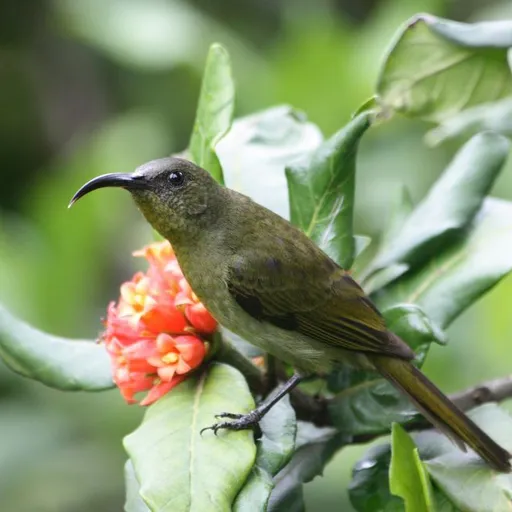
Olive Sunbird
Cyanomitra olivacea
Least Concern
Overview
The Cyanomitra olivacea, or olive sunbird, is a large African species of sunbird within the family Nectariniidae. It is classified as Least Concern on the IUCN Red List due to its widespread distribution across central and southern Africa. The species comprises eleven recognised subspecies that were previously treated as two distinct species but are now considered conspecific.
Identification
- Body colouration ranges from fully dark-olive to dull-olive, with a paler olive-yellow or olive-grey underside.
- Possesses a long, downward-curving bill that varies in colour from solid black to mottled grey, beige, and yellow-orange depending on the subspecies.
- Eastern subspecies may exhibit yellowish-orange pectoral tufts on both sexes, while western subspecies display these tufts only on males.
- Song is loud and accelerates in duration, featuring ascending and descending notes; specific subspecies produce distinct calls such as 'chip' noises or melodic whistles.
Habitat
The species inhabits a variety of environments, including coastal and montane scrublands, woodlands, thickets, and western mangroves, with a preference for forest understories. It is also found in modified habitats such as agricultural lands, gardens, urban areas, and plantations. Its range spans from Senegal and Guinea in the west to Ethiopia, Kenya, and Mozambique in the east, extending into South Africa and Zimbabwe.
Diet
Olive sunbirds are mainly nectarivorous, feeding on nectar, insects, spiders, fruits, berries, seeds, pollen, and banana pulp. They extract nectar by hovering in front of flowers and catch arthropods through gleaning, hawking, and poking at vegetation. Dominant males are highly territorial, securing productive flowering sites and deterring competing birds and bees.
Did you know?
Despite being primarily sedentary, olive sunbirds exhibit partial migration patterns, moving to lower elevations during cold seasons and higher elevations during warm seasons, possibly to compensate for seasonal temperature changes or for breeding conditions. They are also highly motile, capable of traversing forest gaps and navigating between fragmented forest patches and eucalyptus plantations.
Sources
- Wikipedia · CC BY-SA 4.0
- Wikidata · CC0 1.0