
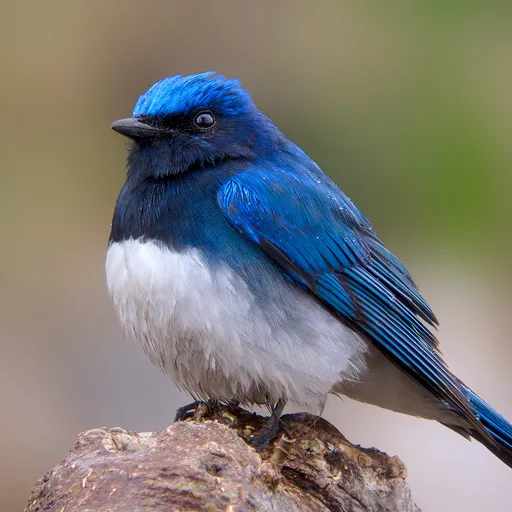
Blue-and-white Flycatcher
Cyanoptila cyanomelana
Least Concern
Overview
The blue-and-white flycatcher (Cyanoptila cyanomelana), also known as the Japanese flycatcher, is a migratory songbird in the Old World flycatcher family. It breeds in Japan, Korea, northeastern China, and the Russian Far East before wintering in South East Asia. Despite a decreasing population, its wide distribution has led to its classification as 'Least Concern' on the IUCN Red List.
Identification
- A large flycatcher measuring 16–17 cm in length and averaging 25 g in weight, with a striking plumage pattern.
- Males feature deep cobalt blue wings with a black face and upper breast, white underparts, and a prominent white patch on the outer tail feathers; females are grey-brown with a pale beige-white throat.
- Immature males possess the blue wings of an adult male but are otherwise brown like females.
- The song consists of a short, melancholic sounding series of whistles.
Habitat
Breeding grounds include primary and secondary lowland and submontane forests, such as taiga, wooded slopes, and gullies, up to 1200 metres elevation, as well as riverine thickets and plantations. Outside the breeding season, the species utilises coastal woodland, scrub, parks, and gardens, and in Borneo it winters in forested hills and lower montane forests up to 1850 metres. These flycatchers are most active in the morning.
Diet
The species feeds mainly on insects and larvae but also consumes berries, including pokeweed.
Did you know?
Although primarily associated with East and Southeast Asia, this species was recorded as a vagrant from the Sinharaja Rainforest in Sri Lanka in 2014.
Sources
- Wikipedia · CC BY-SA 4.0
- Wikidata · CC0 1.0