
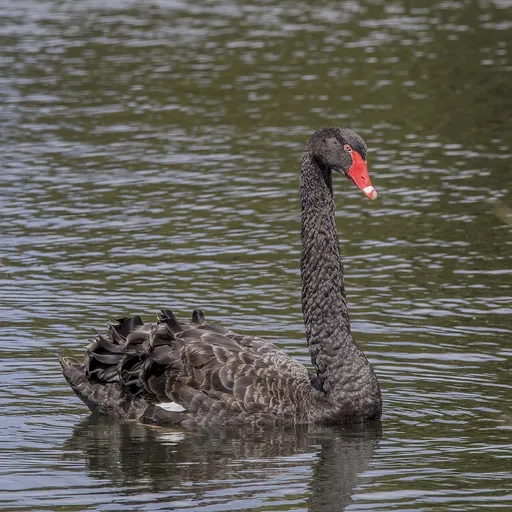
Black Swan
Cygnus atratus
Least Concern
Listen
XC954554 · Sonothèque ADVL · Sougeal, Ille-et-Vilaine, Bretagne, France · CC0 1.0
Overview
The black swan (Cygnus atratus) is a large waterbird that breeds mainly in the southeast and southwest regions of Australia. It is a monogamous breeder, with both partners sharing incubation and cygnet-rearing duties.
Identification
- Plumage: Black feathers with white flight feathers; cygnets are greyish-brown with pale-edged feathers.
- Bill: Bright red with a pale bar and tip; males have longer and straighter bills than females.
- Size and Neck: Measures 110–142 cm in length with a wingspan of 1.6–2 m; features the relatively longest neck among swans, curved in an 'S'-shape.
- Vocalisation: Utters a musical, far-reaching bugle-like sound on water or in flight, as well as softer crooning notes and whistles.
Habitat
Common in the wetlands of southwestern and eastern Australia, the species favours fresh, brackish and salt water lakes, swamps and rivers with underwater and emergent vegetation. It is highly nomadic, moving opportunistically in response to rainfall or drought rather than following a set migratory pattern. Introduced populations now exist in New Zealand, Europe, Japan, the United States and China.
Diet
Almost exclusively herbivorous, the diet is generally dominated by aquatic and marshland plants such as reedmace, submerged algae and stoneworts. The bird feeds by dipping its head and neck under the water in shallow areas, up-ending in deeper water, or filter feeding at the surface.
Did you know?
An estimated one-quarter of all pairings are homosexual, mostly between males, who may steal nests or form temporary threesomes with females to obtain eggs. The bird was introduced to various countries as an ornamental bird in the 1800s, but has managed to escape and form stable populations.
Sources
- Wikipedia · CC BY-SA 4.0
- Wikidata · CC0 1.0