
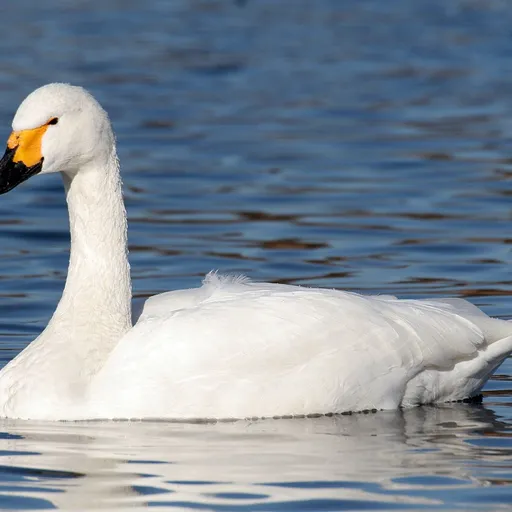
Tundra Swan
Cygnus columbianus
Least Concern
Listen
XC972031 · steve · Sixth Siding, Beaufort County, North Carolina, United States · CC BY-SA 4.0
Overview
The tundra swan (Cygnus columbianus) is the smallest of the Holarctic swans, breeding in the Arctic and overwintering across North America, Europe, and Asia. Classified as Least Concern by the IUCN, it comprises two subspecies: Bewick's swan in the Palaearctic and the whistling swan in the Nearctic.
Identification
- Adults possess entirely white plumage, often with a golden or rusty hue on the head and neck in iron-rich waters, accompanied by solid black feet and dark brown irises.
- The bill is primarily black with a thin salmon-pink streak along the mouthline and variable yellow at the base, which is more extensive in Bewick's swan and minimal in whistling swans.
- Immature birds display white plumage mixed with dull grey feathering on the head and upper neck, while downy young are silvery grey above and white below.
- Vocalisations include high-pitched honks resembling a black goose; Bewick's swans produce a low ringing bark in flight, whereas whistling swans emit a high-pitched trisyllabic bark.
Habitat
Breeding populations inhabit shallow pools, lakes, and rivers in the tundra and subarctic regions, while wintering grounds consist of grasslands, marshlands, and coastal areas, often near agricultural fields. Migrating birds may reach altitudes of 8 km in V formations and frequently stop over at mountain lakes during transit.
Diet
During the summer, tundra swans consume aquatic vegetation such as mannagrass, pondweeds, and marine eelgrass by sticking their heads underwater or upending while swimming. Outside the breeding season, they forage on leftover crops, including potatoes and grains, in open fields after harvest, typically during the daytime.
Did you know?
Brown bears are a surprisingly serious nest predator for tundra swans, having been identified as the primary cause of nesting failure in both the Arctic National Wildlife Refuge and Izembek National Wildlife Refuge. Despite this threat, healthy adult swans can usually stand their ground against most other natural predators.
Sources
- Wikipedia · CC BY-SA 4.0
- Wikidata · CC0 1.0