
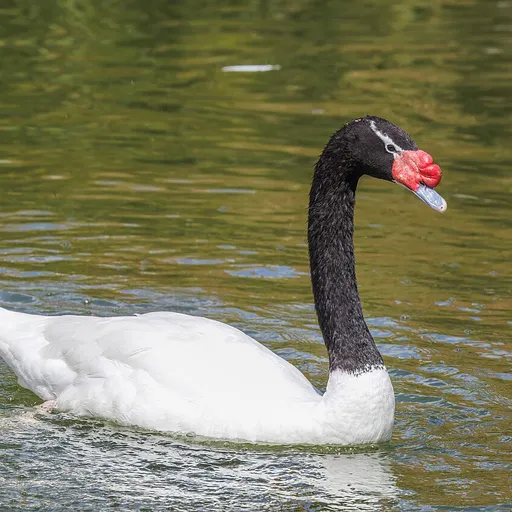
Black-necked Swan
Cygnus melancoryphus
Least Concern
Overview
The black-necked swan (Cygnus melancoryphus) is a large waterfowl native to South America and the Falkland Islands. It is the largest native waterfowl in the southern continent, though it is the lightest of the true swans.
Identification
- Adult plumage features a white body with a distinct black head and neck, often marked by a white stripe behind the eye.
- Males can weigh up to 8.7 kg (19 lb), making them significantly larger than females.
- A prominent red knob is present at the base of the bill in adults, whereas juveniles are greyish and lack this feature.
- The bird is largely silent outside the breeding season, but pairs emit a soft, musical 'Whee-whee-whee' to challenge intruders.
Habitat
Found across the southern tier of South America, including Argentina, Brazil, Chile, Uruguay, and the Falkland Islands, the species inhabits freshwater marshes, shallow lakes, and sheltered coastal sites. It generally favours low elevations but non-breeding flocks may ascend to altitudes of 1,250 metres in the Andes. On the mainland, it is often found near human habitation, whereas it avoids built-up areas in the Falklands.
Diet
The diet is almost entirely vegetarian, consisting of aquatic plants such as Chara, Potamogeton, and Typha, alongside algae and small numbers of invertebrates. Foraging involves immersing the head and neck, surface feeding, and upending to reach deeper water, with occasional grazing in meadows during droughts.
Did you know?
Although generally silent, the black-necked swan produces a distinct 'hooee-hoo-hoo' sound, with the male's call being specifically described as musical. During the breeding season, pairs use a repeated 'Whee-whee-whee' vocalisation to maintain contact and defend their territory.
Sources
- Wikipedia · CC BY-SA 4.0
- Wikidata · CC0 1.0