
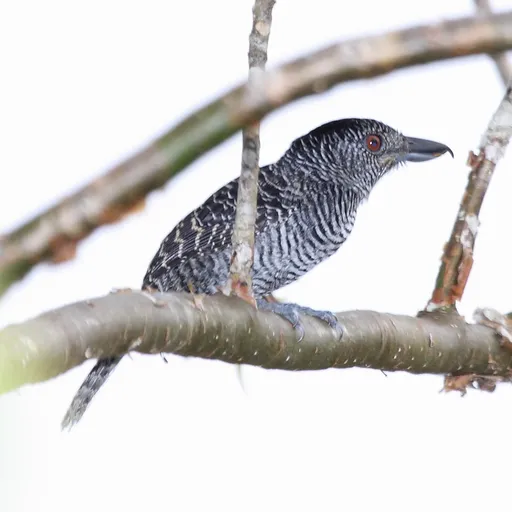
Fasciated Antshrike
Cymbilaimus lineatus
Least Concern
Listen
XC250756 · Niels Krabbe · Napo: 'Gareno (Guaponi) Lodge', Ecuador · CC BY-SA 4.0
Overview
The fasciated antshrike (Cymbilaimus lineatus) is a species of typical antbird belonging to the subfamily Thamnophilinae. It is found across Central America from Honduras south, and in most mainland South American countries except Argentina, Chile, Paraguay, and Uruguay. The species is currently assessed as Least Concern by the IUCN.
Identification
- Length of 17 to 18 cm with a weight of 35 to 40 g, featuring a heavy bill with a hook at the end and red irises.
- Males of the nominate subspecies display a black forehead and crown with thin white bars, while the rest of the plumage consists of thin black and white bars.
- Females possess a rufous crown with thin dark brown and pale yellowish brown bars on the body, and a tail barred with dark brown and pale buff.
- Song comprises an evenly paced series of 3–10 plaintive, lazily delivered whistles that are longer than the spaces between them, often described as sounding like "weh".
Habitat
This species inhabits evergreen primary and secondary forests in lowlands and Andean foothills, favouring vine tangles and dense mid-storey vegetation. It occurs at elevations generally below 800 m, though locally reaching higher altitudes in parts of Brazil, Costa Rica, Colombia, and Ecuador. In Central America, it tends towards second growth and thickets, while elsewhere it frequents both forest interiors and edges.
Diet
The fasciated antshrike feeds primarily on large insects, supplemented by spiders, small lizards, frogs, and small amounts of fruit. It forages singly or in pairs, often joining mixed-species feeding flocks, and typically feeds in vine clusters or near tree trunks between 5 and 20 m above the ground. It hops sluggishly through vegetation to reach prey and may follow army ants, though it is not an obligate ant-follower.
Did you know?
Although the fasciated antshrike shares its genus with the bamboo antshrike and their ranges overlap, the bamboo species generally occurs at higher elevations. It is also more often heard than seen because it mostly stays high in dense vegetation.
Sources
- Wikipedia · CC BY-SA 4.0
- Wikidata · CC0 1.0