
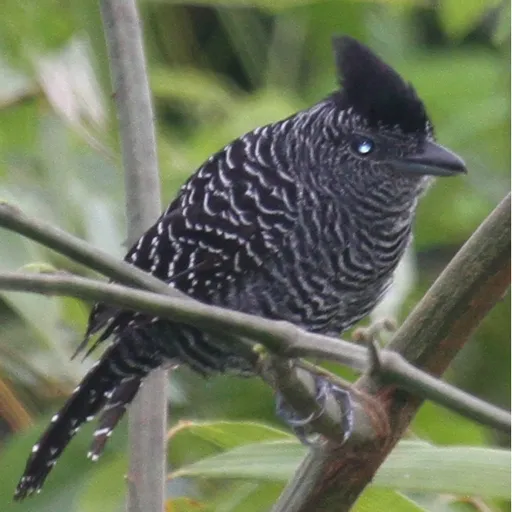
Bamboo Antshrike
Cymbilaimus sanctaemariae
Least Concern
Overview
The bamboo antshrike is a species of bird in the family Thamnophilidae, commonly known as the typical antbirds. It is a monotypic species found in the western Amazon Basin, specifically in Bolivia, Brazil, and Peru. Despite its specific name, it is occasionally found in dense vine tangles of floodplain forest even where bamboo is absent.
Identification
- Small bird measuring 16 to 17 cm in length with a small crest and a somewhat heavy bill featuring a hook at the end similar to true shrikes.
- Males display a black forehead and crown with the rest of the plumage consisting of thin black and white bars, while females have a rufous crown with black-tipped crest feathers.
- Female upperparts and tail show thin dark brown and pale yellowish brown bars, with a plain buffy white throat and cinnamon-buff underparts that are darker barred on the sides.
- Song consists of a loud, slightly descending series of 8-15 ringing metallic 'tchink' notes, accompanied by sharp 'tchew!' calls, thin dry rattles, and whining 'ewwee?' notes.
Habitat
This species almost exclusively inhabits stands of bamboo, typically of the genus Guadua, in humid lowland and foothill forests, favouring the upper levels of the bamboo. It can also be found in dense tangles of vines in floodplain forest without bamboo, ranging from the mid-storey to the canopy. Its range extends up to an elevation of approximately 1,450 m in the western Amazon Basin of southeastern Peru, western Brazil, and northwestern Bolivia.
Diet
The diet is known to include insects, though details remain sparse. Foraging is conducted singly or in pairs, and occasionally by joining mixed-species feeding flocks. It feeds primarily by gleaning or making short sallies from a perch while hopping along branches and bamboo stems, sometimes reaching up to 20 m above the ground in trees overhanging bamboo stands.
Did you know?
Until the 1980s, the bamboo antshrike was classified as a subspecies of the fasciated antshrike. It remains one of only two species within its genus, Cymbilaimus.
Sources
- Wikipedia · CC BY-SA 4.0
- Wikidata · CC0 1.0