
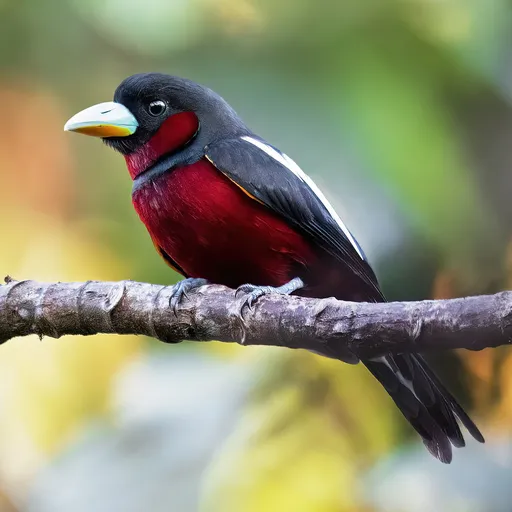
Black-and-red Broadbill
Cymbirhynchus macrorhynchos
Least Concern
Overview
The black-and-red broadbill (Cymbirhynchus macrorhynchos) is a large, distinctive bird belonging to the typical broadbill family, Eurylaimidae, and is the sole representative of the genus Cymbirhynchus. It is distributed across various lowland areas in Southeast Asia, including Brunei, Cambodia, Indonesia, Laos, Malaysia, Myanmar, Singapore, Thailand, and Vietnam. Although its population is thought to be decreasing in some regions, the species is currently listed as Least Concern by the IUCN due to its wide range.
Identification
- Plumage: Features black heads and breastbands, greenish-black upperparts, and bright maroon rumps, uppertail coverts, and a half-collar. Scapulars have pure white edges forming a white line on the closed wing, with a narrow orange line at the wing bend; the tail is black with variable amounts of white.
- Bill: Possesses a large, boat-like bill that is dichromatic, with a bright turquoise-blue maxilla and a yellow-orange mandible featuring a blue tip and edges.
- Eyes and Feet: Has bright emerald green irises in adults and bright blue feet that are sometimes tinged violet.
- Vocalizations: Generally quiet compared to other broadbills, producing ascending 'weeet' sounds similar to those of the black-and-yellow broadbill but shorter and softer, along with a rising cicada-like trill and rapid 'pip' alarm notes.
Habitat
The species primarily inhabits lowland riparian forest edges up to 300 m, occasionally reaching 900 m, including screw-palm swamps near mangroves and peat swamp forests. It rarely enters closed-canopy forest but adapts well to disturbed environments such as secondary forest, degraded riverine habitats, and rubber plantations with water channels.
Diet
Mainly insectivorous, the bird feeds on ants, beetles, crickets, and caterpillars, supplemented by riverine creatures such as mollusks, snails, crustaceans, and small fish. It forages by seizing prey from the ground and water's edge, and has been observed catching flying moths from above streams.
Did you know?
The species builds conspicuous nests that usually hang over water, constructed from materials including creepers, fungal hyphae, and moss, with the structure sometimes built far from water or over roads. Its bright red plumage is derived from the biological pigment 2,3-didehydro-papilioerythrinone, which is also found in related broadbill genera.
Sources
- Wikipedia · CC BY-SA 4.0
- Wikidata · CC0 1.0