
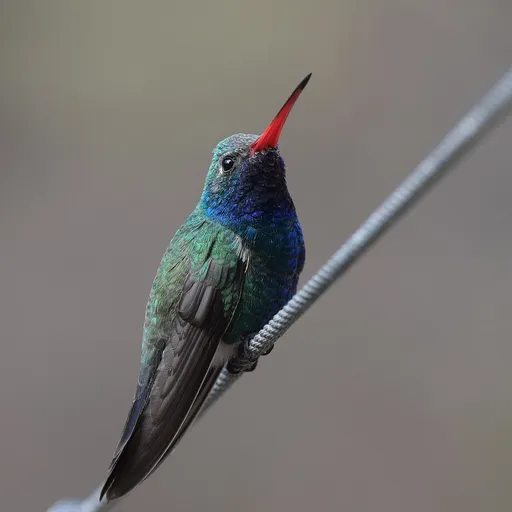
Broad-billed Hummingbird
Cynanthus latirostris
Least Concern
Overview
The broad-billed hummingbird (Cynanthus latirostris) is a small hummingbird found in Mexico and the southwestern United States. It is a diurnal species characterized by sexual dimorphism, with males and females displaying distinct physical features.
Identification
- Metallic green upperparts with dull colouring on the crown and forehead.
- Long, bright reddish bill with a black tip; males possess a slightly shorter but brighter red bill.
- Males feature a blue gorget, white undertail-coverts, and blackish-blue broad tails, while females have pale bellies, white eyestripes, and white-tipped tail feathers.
- Chatter resembles a rapid 'chi-dit' similar to a Ruby-crowned Kinglet; males produce a whining 'zing' display call.
Habitat
Found in the southwest United States, Sonora, and central Mexico, this species inhabits streamside groves, oak woodlands, arid thorn forests, and tropical deciduous forests. In the United States, it favours areas with Arizona sycamore, Fremont cottonwoods, and mesquite, while in Mexico it is a common resident of arid thorn and riparian gallery forests along the Pacific coast.
Diet
The broad-billed hummingbird feeds on nectar and insects, preferring red or red-and-yellow flowers such as agave, desert honeysuckle, and milkweed. It accesses nectar by hovering and extending its bill, though it often perches at artificial feeders. When competing with other species, it may feed on flowers with low-nectar availability, and it catches insects midair or plucks them from plants.
Did you know?
Although the species was formally described in 1827 with a type locality specified as 'Table Land?', it is likely that the bird does not actually occur there, a discrepancy noted over a century before the location was corrected to the Valley of Mexico.
Sources
- Wikipedia · CC BY-SA 4.0
- Wikidata · CC0 1.0