
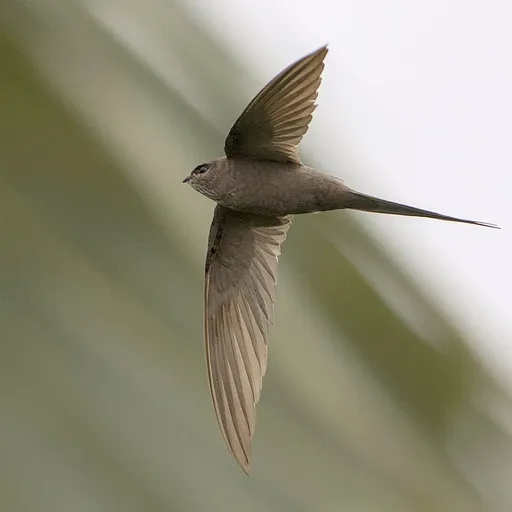
African Palm Swift
Cypsiurus parvus
Least Concern
Overview
The African palm swift (Cypsiurus parvus) is a small, common swift that spends most of its life in the air. It was formerly considered the same species as the Asian palm swift but is now distinguished, with the Malagasy palm swift also recently split from it. Rated as 'least concern' by the IUCN, its population may be increasing due to the cultivation of exotic Washington palms.
Identification
- Approximately 16 cm in length, with a slender body and long, deeply forked tail that is usually held closed.
- Primarily pale brown plumage with long, swept-back wings that resemble a crescent or boomerang.
- Possesses very short legs used solely for clinging to vertical surfaces, as the bird never voluntarily settles on the ground.
- Produces a loud, shrill screaming call.
Habitat
Native to a vast range across Africa, including Angola, Botswana, Kenya, South Africa, and Tanzania, extending to parts of the Arabian Peninsula. It is a resident breeder in tropical Africa, favouring open country such as wooded savannah, thornbush, and cultivated land. The species is strongly associated with oil palms, where it constructs its nest.
Diet
This species lives on insects caught in its beak while in flight, often feeding near the ground. It is a fast-flying bird that also drinks water on the wing.
Did you know?
The bird constructs its down and feather nest by gluing it to the underside of a palm frond using its own saliva, which also secures the usual clutch of two eggs.
Sources
- Wikipedia · CC BY-SA 4.0
- Wikidata · CC0 1.0