
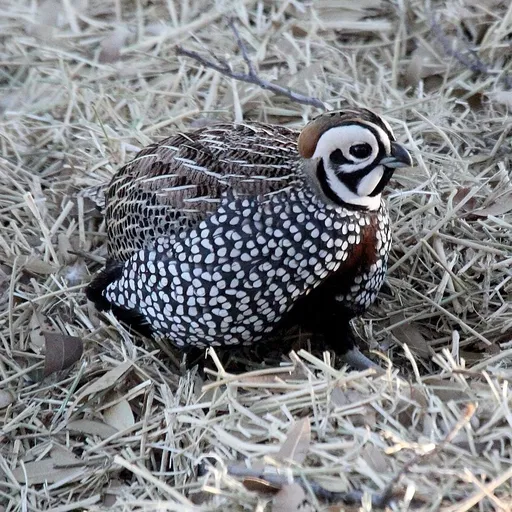
Montezuma Quail
Cyrtonyx montezumae
Least Concern
Listen
XC492136 · Diana Doyle · Hereford, Cochise County, Arizona, United States · CC BY-SA 4.0
Overview
The Montezuma quail (Cyrtonyx montezumae) is a stubby, secretive New World quail native to Mexico and parts of the United States. It is also known as Mearns's quail, the harlequin quail, and the fool quail due to its behaviour.
Identification
- Stubby, plump build with a length of 20–23 cm, making it one of the shortest quails in North America.
- Both sexes have tan backs and wings with light-buff streaks and black spots, plus a distinctive nape crest.
- Adult males display a striking, swirling black-and-white face pattern and blue-grey sides with bold spots, while females show a fainter version of the facial markings.
- Uniquely long, sickle-shaped claws used for digging.
- The male's song is an eerie, descending whistle or buzzing emitted from the ground rather than a perch.
Habitat
Found from Oaxaca north through the interior of Mexico to central and southeastern Arizona, central and southwestern New Mexico, and West Texas, avoiding deserts and the Río Balsas valley. It inhabits open woods, typically oak, pine-oak, or juniper, where grass is at least 30 cm tall. Hillslopes and canyons are particularly favoured, though the range is currently decreasing and becoming fragmented.
Diet
The diet consists of insects, particularly in summer, as well as plants including Oxalis and sedge tubers. The bird uses its long claws to dig holes up to 8 cm deep at the bases of bushes and rocks to unearth these food sources. It can even find bulbs that have no above-ground growth during certain seasons.
Did you know?
Montezuma quail build an unusually elaborate grass dome nest with a single entrance, and there is a significant delay of months between pairing in early spring and actual nesting in the monsoon season. Their sedentary nature means coveys often forage within 50 m of where they fed the previous day.
Sources
- Wikipedia · CC BY-SA 4.0
- Wikidata · CC0 1.0