
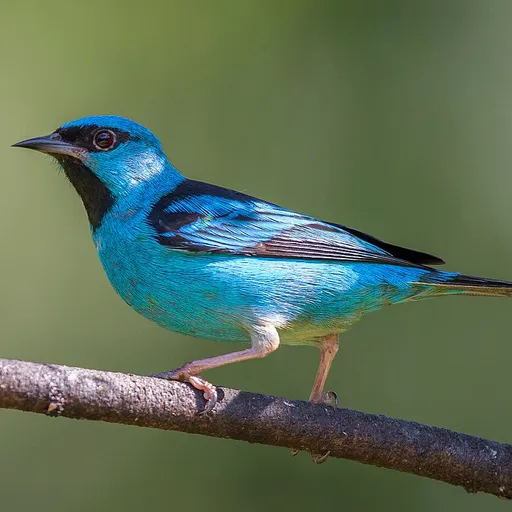
Blue Dacnis
Dacnis cayana
Least Concern
Overview
The blue dacnis, or turquoise honeycreeper (Dacnis cayana), is a small passerine bird in the family Thraupidae. It is widespread across Central and South America, found in every mainland South American country except Chile and Uruguay, as well as on Trinidad.
Identification
- 11 to 12 cm in length with a thin, pointed bill.
- Sexually dimorphic; adult males display mostly turquoise-blue plumage with a black mantle and thin black mask, while females are mostly green with bluish heads.
- Dark red to reddish-brown irises and pinkish legs are present in both sexes.
- Song consists of a wheezy series of thin, high notes such as "wee-tee tsee-tew", interspersed with weak call notes like "tsit" or "chit-it".
Habitat
This species inhabits a variety of moist to wet landscapes, including terra firme and várzea forests, secondary forest, and gallery forest. It ranges in elevation from sea level up to approximately 1,500 m, varying by region.
Diet
The blue dacnis feeds on arthropods, fruit, seeds, and possibly nectar, with Miconia berries and Euphorbiaceae being significant components of its diet. It primarily forages singly or in pairs, almost always joining mixed-species feeding flocks, and may feed acrobatically by hanging upside down or sallying for insects.
Did you know?
The purplish honeycreeper, known only from a type specimen in Venezuela, is considered an intergeneric hybrid between the green honeycreeper and either the red-legged honeycreeper or the blue dacnis.
Sources
- Wikipedia · CC BY-SA 4.0
- Wikidata · CC0 1.0