
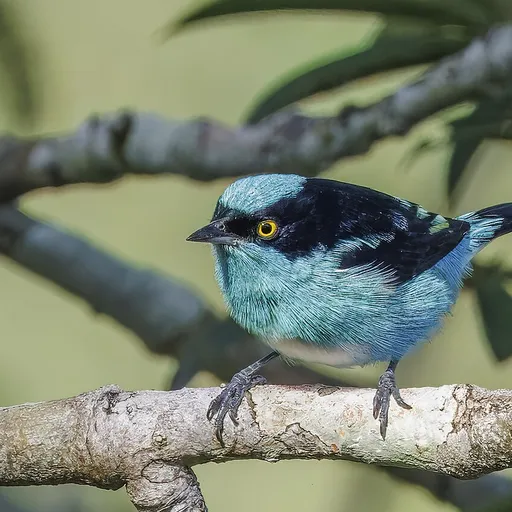
Black-faced Dacnis
Dacnis lineata
Least Concern
Overview
The black-faced dacnis (Dacnis lineata) is a small bird in the tanager family Thraupidae, found across much of mainland South America. It is a year-round resident classified as Least Concern on the IUCN Red List, though its population is believed to be decreasing.
Identification
- Males feature a turquoise blue crown, a wide black mask, and a black mantle contrasting with turquoise scapulars, rump, and upper tail coverts.
- Females are olive-brown on the head and upperparts with pale greyish throats and buffy white central bellies.
- Adults have a thin, sharply pointed bill that is black with a grey base, yellow irises, and blackish legs.
- The song is a prolonged, jumbled series of buzzy, modulated notes mixed with high-pitched calls and loose trills, with the most common sound being a short 'Tsrrip'.
Habitat
Native to the Amazon Basin and Guiana Shield, this species inhabits the canopy and edges of humid terra firme and várzea forest, as well as clearings with scattered trees and shade coffee plantations. Its range spans western Venezuela south through Colombia, Ecuador, Peru, and Bolivia, extending east into northern Brazil, though it is absent from Argentina, Chile, Paraguay, and Uruguay.
Diet
Primarily feeding on arthropods and small fruits, the black-faced dacnis likely also consumes nectar. It forages mostly in pairs or within family groups and joins mixed-species flocks, actively seeking food in the canopy by hanging upside down or gleaning prey from leaves while briefly hovering after a short sally from a perch.
Did you know?
The species is remarkably elusive to birders, with its song described as 'rarely heard' and its presence in Venezuela noted as 'rather spotty' despite a very large range.
Sources
- Wikipedia · CC BY-SA 4.0
- Wikidata · CC0 1.0