
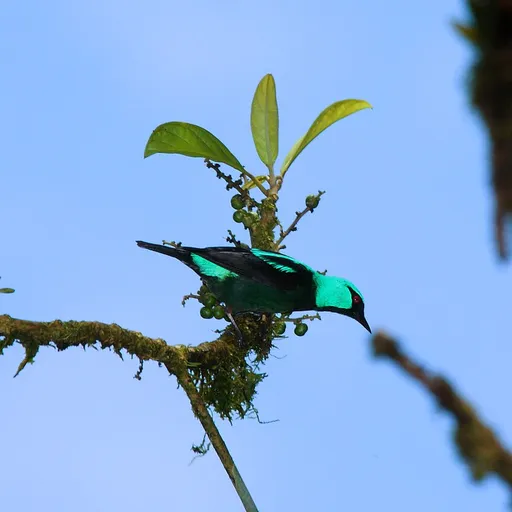
Scarlet-thighed Dacnis
Dacnis venusta
Least Concern
Overview
The scarlet-thighed dacnis (Dacnis venusta) is a species of bird in the family Thraupidae, classified as Least Concern by the IUCN. It is a year-round resident found across parts of Central and South America. The species comprises two subspecies: the nominate D. v. venusta and D. v. fuliginata.
Identification
- Males are sexually dimorphic, featuring a turquoise-blue head and back with a triangular black mask, black wings and tail, and deep greenish-black underparts.
- The eponymous scarlet thighs are present but usually not visible, while females appear greenish olive with bright blue tinges on the face and upperparts.
- The bird is small, measuring 11 to 12 cm in length, and possesses a short, pointed bill.
- Vocalisations include two to three scratchy, insect-like trills ending with a squeaky 'bzzeek', alongside metallic calls such as 'urp' or 'zirp'.
Habitat
This species primarily inhabits the canopy and edges of evergreen forests in tropical and subtropical zones, also occurring in gaps from fallen trees, around lakes, cleared areas, and shady plantations. Its range spans from north-central Costa Rica and Panama into Colombia and northwestern Ecuador. Elevation varies by region, reaching up to 1,500 m in Costa Rica, 1,000 m in Colombia, and 800 m in Ecuador.
Diet
The scarlet-thighed dacnis feeds on small fruits, arthropods, and nectar, foraging very actively in the forest subcanopy and canopy. It gleans prey and fruit from live foliage, often moving through the environment singly, in pairs, or in family groups. It regularly joins mixed-species feeding flocks to locate food sources.
Did you know?
The genus name Dacnis derives from the Greek for an Egyptian bird whose identity remains unknown. The specific epithet venusta comes from the Latin word for 'lovely'.
Sources
- Wikipedia · CC BY-SA 4.0
- Wikidata · CC0 1.0