
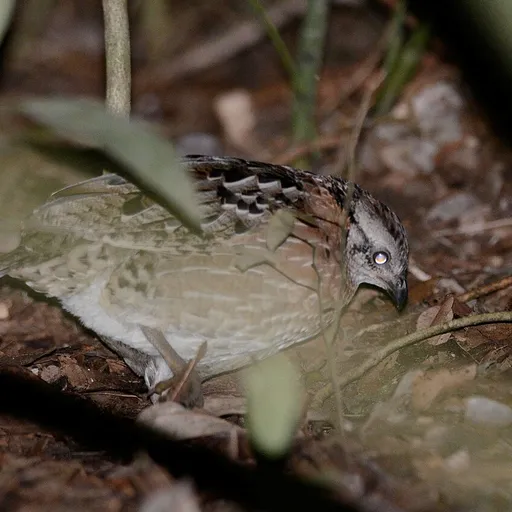
Singing Quail
Dactylortyx thoracicus
Least Concern
Listen
XC283001 · Tour Guide Salvatore · Santiago Atitlán, Solola, Guatemala · CC BY-SA 4.0
Overview
The singing quail (Dactylortyx thoracicus) is a species of New World quail found across parts of Central and North America. It is the sole member of its genus and is currently assessed as Least Concern by the IUCN due to its wide range and resilience to habitat changes.
Identification
- Length of 20 to 23 cm, with males weighing 180–266 g and females 115–206 g.
- Males feature a dark brown crown, a buff and black 'collar', and a tawny orange face marked by a black streak behind the eye.
- Females have a gray face and white throat, with paler brown breasts and flanks.
- Song consists of loud, rhythmic whistles that increase in frequency and pitch, often delivered by multiple birds.
Habitat
Found in northern, western, and southern Mexico, the Yucatán Peninsula, Belize, Guatemala, El Salvador, and Honduras. It inhabits forest floors with sparse undergrowth, older secondary forests, clear cuts, and coffee plantations, ranging in elevation from sea level to at least 3,000 m.
Diet
Frequently forages in coveys of three to five birds, though groups of up to twelve have been observed. It scratches in leaf litter and soil to feed on bulbs, seeds, and insects.
Did you know?
The singing quail is apparently more capable of withstanding habitat destruction and fragmentation than other quails in Middle America.
Sources
- Wikipedia · CC BY-SA 4.0
- Wikidata · CC0 1.0