
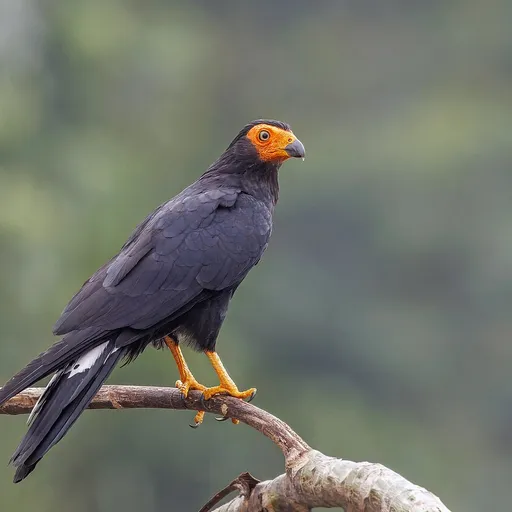
Black Caracara
Daptrius ater
Least Concern
Listen
XC250764 · Niels Krabbe · Zamora-Chinchipe: 1-2 km W Shaimi, Nangaritza Valley, Ecuador · CC BY-SA 4.0
Overview
The Daptrius ater is a small bird of prey in the family Falconidae, characterised by its glossy black plumage and sociable nature. It is a widespread and resident species found in the lowlands of the Amazon, French Guiana, and surrounding regions.
Identification
- Adults are glossy black with a distinctive white band at the base of the tail, a black beak, and yellow to orange-red feet and facial skin.
- Long, narrow wings and tail, reaching an average length of 41–47 cm.
- Flight is characterised by continuous active wing-flapping rather than soaring.
- Vocalisation consists of a harsh, piercing single-note kraaaa call, often repeated during flight with a decrescendo.
- Juveniles possess dull black plumage, a pale yellow face, and 3–4 black bars on the tail feathers.
Habitat
The black caracara inhabits subtropical and tropical moist lowland forests, heavily degraded former forests, gallery forests, and wooded savannas from sea level up to 900 m altitude. It is strongly associated with riverine environments and can also be found in mangroves and disturbed forested habitats near water. The species occurs across Bolivia, Brazil, Colombia, Ecuador, French Guiana, Guyana, Peru, Suriname, and Venezuela.
Diet
As an opportunistic omnivorous predator, this species consumes a diverse range of foods including nestlings, small mammals, reptiles, invertebrates, fruits, palm nuts, carrion, and fish. It forages by searching the canopy for insects, robbing bird nests, scavenging near human settlements, and hunting fish in fast-flowing rivers by walking on rocks and peering into the water.
Did you know?
The black caracara engages in a mutualistic relationship with tapirs, where it removes ectoparasites and insects from the tapirs' fur in exchange for being solicited by the tapir's calls. This interaction is so specific that the species is also known as gavião-de-anta, literally translating to 'tapir-hawk'.
Sources
- Wikipedia · CC BY-SA 4.0
- Wikidata · CC0 1.0