
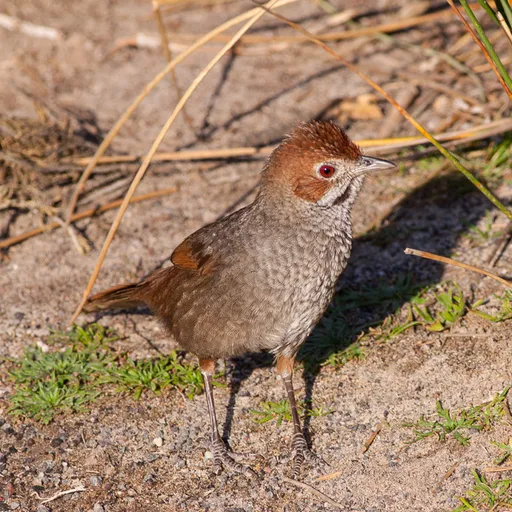
Rufous Bristlebird
Dasyornis broadbenti
Least Concern
Overview
The rufous bristlebird is a medium-sized, predominantly brown bird endemic to Australia and is one of only three extant species of bristlebird. It is found in coastal shrublands and heathlands across parts of South Australia and Victoria, though one western subspecies is now extinct.
Identification
- Predominantly brown plumage with a rich rufous head and ear coverts, and a long tail with short, rounded wings.
- A light grey marking surrounds the reddish eye and extends to the bill.
- The throat and breast feature dark scalloping, which can be white in western populations.
- Loud, complex song repertoires consisting of 12 to 30 distinct song types, often used for detection as the bird is rarely sighted.
Habitat
The species inhabits dense coastal shrublands, heathlands, and forests with a bracken or shrub understory, preferring low-altitude areas near coastal edges and drainage systems. Its range is currently limited to coastal South Australia and western Victoria, having lost its former population in Western Australia to habitat loss and fire.
Diet
Rufous bristlebirds forage on the ground, in leaf litter, and within short shrubs for seeds, small invertebrates, grubs, and terrestrial snails. They move through dense vegetation by running or flying short distances to catch prey.
Did you know?
Rufous bristlebirds communicate through complex song repertoires with no overlap between the sexes, and historically, early settlers used dogs to flush the birds out of the undergrowth for visual identification.
Sources
- Wikipedia · CC BY-SA 4.0
- Wikidata · CC0 1.0