
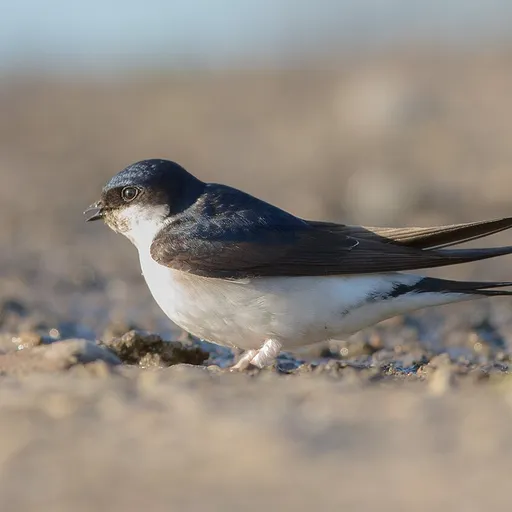
Western House Martin
Delichon urbicum
Least Concern
Listen
XC818517 · Sonothèque ADVL · Genêts, Manche, Normandie, France · CC0 1.0
Overview
The western house martin, also known as the common or northern house martin, is a migratory passerine bird belonging to the swallow family. It breeds across temperate regions of Europe, north Africa and west-central Asia, and winters in sub-Saharan and southwestern Africa. The species is classified as Least Concern on the IUCN Red List due to its extensive global range.
Identification
- Steel-blue upperparts with a pure white rump and underparts, including white downy feathering on the legs.
- A small black bill, brown eyes, and pink toes and exposed leg parts.
- A soft twittering song of melodious chirps from males, accompanied by a hard contact call and a shrill alarm.
- Distinguished from similar species by its pure white rump and underparts, unlike the Asian house martin which has greyish underparts.
Habitat
This species prefers open country with low vegetation such as pastures, meadows and farmland, often near water, and is highly adaptable to urban environments, nesting under the eaves of human-made structures. It migrates on a broad front to winter in sub-Saharan and southwestern Africa, where it tends to fly at higher altitudes and inhabit elevated areas. It also uses reed beds for roosting less frequently than other swallows, preferring trees for shelter.
Diet
The western house martin is an aerial insectivore that catches flying insects such as flies, aphids and flying ants while in flight. During the breeding season, it hunts at an average height of 21 m within 450 m of its nest, often over open ground or water, and may follow ploughs or large animals to catch disturbed insects. In winter, it forages at greater heights, often over 50 m.
Did you know?
Although the western house martin is socially monogamous, it is genetically polygamous, with up to 32% of broods containing at least one extra-pair chick from an unrelated male.
Sources
- Wikipedia · CC BY-SA 4.0
- Wikidata · CC0 1.0