
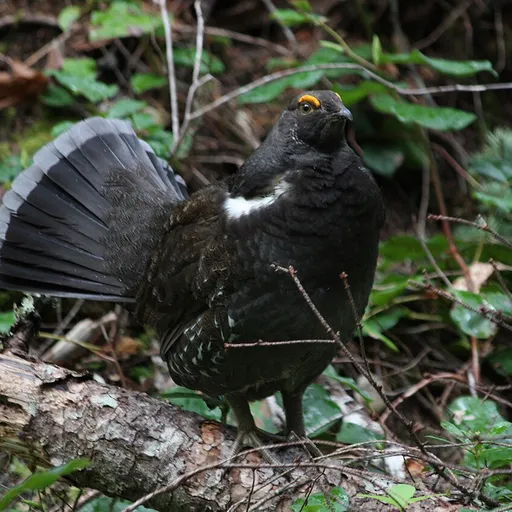
Sooty Grouse
Dendragapus fuliginosus
Least Concern
Overview
The sooty grouse (Dendragapus fuliginosus) is a forest-dwelling bird native to the Pacific Coast Ranges of North America. It is closely related to the dusky grouse, and both species were previously classified as a single entity known as the blue grouse. Currently listed as Least Concern by the IUCN, the species faces potential risks from habitat loss in old-growth forests.
Identification
- Adult males are predominantly dark, featuring a yellow throat air sac surrounded by white and a yellow wattle over the eye during display.
- Adult females are mottled brown with dark brown and white markings on the underparts and possess longer, skinnier necks than males.
- The species averages 40–50 cm (16–20 in) in length, with males having stouter bodies than females.
- Both sexes possess a long square tail that is light gray at the end.
Habitat
Breeding habitat consists of the edges of conifer and mixed forests in mountainous regions of western North America, stretching from southeastern Alaska and Yukon down to California. The species thrives in old forests due to a need for diverse plants and trees, though regenerated logged or burned areas are also used if sufficient bushes and shrubs are available for nesting. Although permanent residents, they shift to deeper coniferous forests and occasionally higher altitudes during winter.
Diet
Foraging occurs on the ground or in trees during winter, when the diet consists mainly of fir, Douglas-fir, hemlock, and pine needles. In summer, they consume other green plants, berries, and insects such as ants, beetles, and grasshoppers, while chicks rely almost entirely on insects for their first ten days. The birds also ingest grit and tiny stones to assist in grinding food within the gizzard.
Did you know?
Sooty grouse exhibit an unusual migratory pattern by moving to higher altitudes in winter to reach denser forest areas. They are also capable of surviving on a diet of fir needles alone during the winter months.
Sources
- Wikipedia · CC BY-SA 4.0
- Wikidata · CC0 1.0