
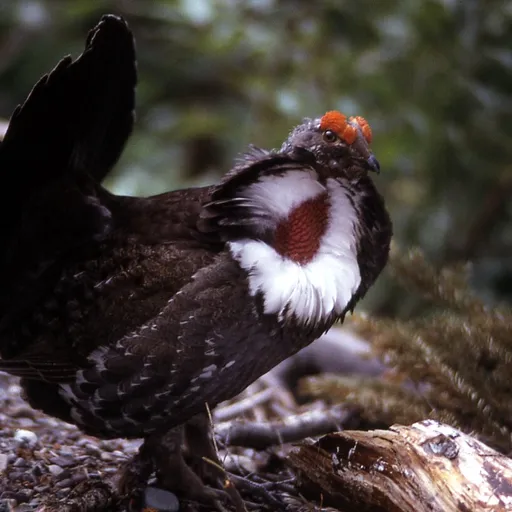
Dusky Grouse
Dendragapus obscurus
Least Concern
Overview
The dusky grouse (Dendragapus obscurus) is a species of forest-dwelling grouse native to the Rocky Mountains in North America. It is closely related to the sooty grouse, and the two were previously considered a single species known as the blue grouse.
Identification
- Adult males are mainly dark, featuring a purplish throat air sac surrounded by white and a yellow to red wattle over the eye during display.
- Adult females are mottled brown with dark brown and white marks on the underparts.
- Males are larger than females, with a mean body mass of 1.21 kg compared to 0.91 kg in females.
- Adults possess a long square tail that is gray at the end.
Habitat
The breeding habitat consists of the edges of conifer and mixed forests in mountainous regions of western North America, ranging from southeastern Alaska and Yukon south to New Mexico. Their range is closely associated with that of various conifers, and they are permanent residents that may move to higher altitudes during winter.
Diet
Dusky grouse forage mainly for plant matter on the ground, as well as in trees and along branches during winter, when they primarily consume fir and Douglas-fir needles. In spring and summer, they eat fresh green growth of herbaceous perennials and berry plants, along with invertebrates such as ants, beetles, crickets, and grasshoppers. Chicks are almost entirely dependent on insect prey for several weeks after hatching.
Did you know?
Males sing with deep hoots on their territory and make short flapping flights to attract females. Females leave the male's territory after mating.
Sources
- Wikipedia · CC BY-SA 4.0
- Wikidata · CC0 1.0