
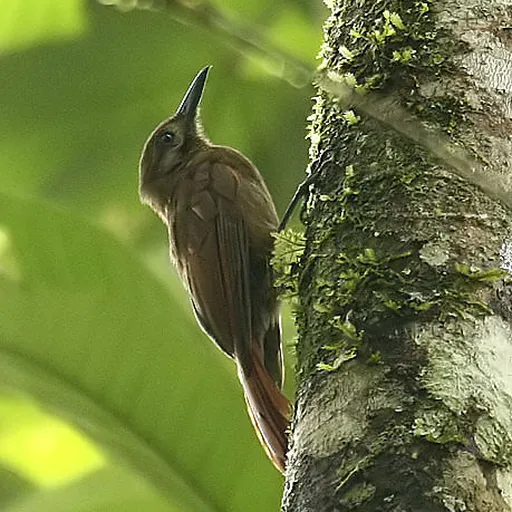
Plain-brown Woodcreeper
Dendrocincla fuliginosa
Least Concern
Listen
XC248796 · Niels Krabbe · Orellana: Laguna Añangu ('Napo Wildlife Center'), s-bank Río Napo, Ecuador · CC BY-SA 4.0
Overview
The plain-brown woodcreeper, Dendrocincla fuliginosa, is a sub-oscine passerine bird in the ovenbird family Furnariidae. It is the most common and widespread Dendrocincla woodcreeper, found in tropical habitats across the New World from Honduras to central Brazil.
Identification
- Medium-sized passerine, 19 to 22.5 cm long, with a straight medium-length bill and a slight crest.
- Nominate subspecies feature a narrow buff supercilium, a dull olive-brown crown and back, rufous-chestnut uppertail coverts and tail, and paler olive-brown underparts with fine buff streaks.
- Song is described as a long whinny, rattle, or sputter, sometimes transcribed as "Whee-hee-he-hah" or "weekweekweek---".
- Common calls include sharp "peeyk", "stieek", and "squeeeik".
Habitat
Found from Honduras through South America to central Brazil and Trinidad and Tobago, inhabiting a variety of humid forest landscapes such as evergreen, deciduous, and gallery forests. It primarily favours the interior of primary forest but is frequently found at edges and in mature secondary forest, seldom occurring above 1,300 m elevation.
Diet
Forages mostly in the lower to mid-levels of the forest, feeding on a wide variety of arthropods such as beetles and orthoptera, as well as small vertebrates like lizards. It often follows army ant swarms to catch fleeing prey but is not an exclusive ant-follower, and also forages with coatis and monkeys.
Did you know?
Pairs appear to bond only briefly, and only females are known to incubate eggs and tend nestlings.
Sources
- Wikipedia · CC BY-SA 4.0
- Wikidata · CC0 1.0