
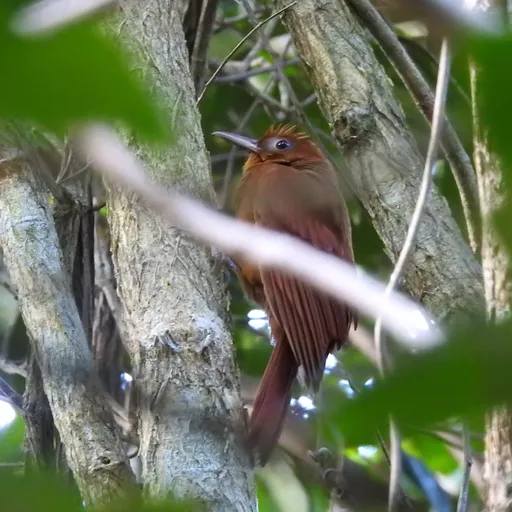
Ruddy Woodcreeper
Dendrocincla homochroa
Least Concern
Listen
XC764181 · Andrea Martinez · Chuluc, Chemax Municipality, Yucatán, Mexico · CC BY 4.0
Overview
The ruddy woodcreeper (Dendrocincla homochroa) is a passerine bird in the ovenbird family Furnariidae. It is a medium-sized species found in Central and South America, ranging from southern Mexico to northern Colombia and extreme northern Venezuela.
Identification
- Medium-sized bird measuring 17.5 to 20.5 cm in length, with a large head featuring a ruffled nape, a short tail, and a straight bill.
- Upperparts are dark rufous to chestnut-brown with a brighter reddish crown, while wings, uppertail coverts, and tail are rufous chestnut with dusky primary tips.
- Underparts are rufous brown with a paler belly and rufous undertail coverts; the throat is cinnamon-buff to tawny-ochraceous.
- Legs and feet are pale grayish to grayish brown, and the iris is reddish brown to pale chestnut-brown.
Habitat
Inhabits a variety of forest landscapes including lowland deciduous forest, rainforest, cloudforest, and gallery forest, favouring the interior of mature primary and secondary forest but also occurring at edges and in semi-open areas. It is generally a bird of lowlands and foothills, typically found below 1,500 m, though elevations vary by region. The species is mostly a year-round resident throughout its range.
Diet
The ruddy woodcreeper is a near-obligate follower of army ant swarms, though it does not feed on the ants themselves. It typically clings to a trunk up to 10 m above the ground, making short flights to capture arthropod prey disturbed by the ants, and occasionally forages in epiphytes. It occasionally joins mixed-species feeding flocks away from ant swarms.
Did you know?
Although the ruddy woodcreeper is a near-obligate follower of army ant swarms, it specifically captures arthropod prey disturbed by the ants rather than eating the ants themselves.
Sources
- Wikipedia · CC BY-SA 4.0
- Wikidata · CC0 1.0