
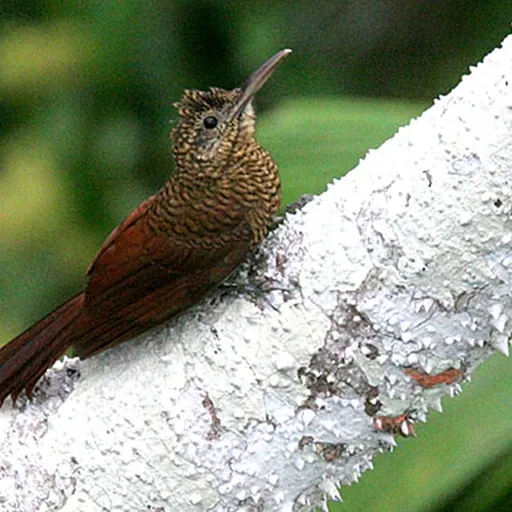
Amazonian Barred Woodcreeper
Dendrocolaptes certhia
Least Concern
Listen
XC249818 · Niels Krabbe · Morona-Santiago: w-slope Cord. de Cutucú, Ecuador · CC BY-SA 4.0
Overview
The Amazonian barred woodcreeper, Dendrocolaptes certhia, is a sub-oscine passerine bird belonging to the ovenbird family Furnariidae. It is classified as a species of Least Concern by the IUCN, with a very large range across the Amazon Basin. This resident bird is generally stable in population size, though certain subspecies face local threats from habitat loss.
Identification
- One of the larger woodcreepers, measuring 26 to 28.5 cm in length, with a slim body and long tail.
- Males possess a shaggy crest, while both sexes have a medium-length straight bill with a slightly hooked tip.
- The nominate subspecies features a mostly brownish face with fine barring, darkish olive-brown crown with golden-buff streaks, and cinnamon-rufous to rufous-chestnut flight feathers, rump, and tail.
- Underparts are deep buff to fulvous with fine dusky bars, contrasting with a pale gray to dirty white chin and throat.
- Song consists of a rapidly delivered series of 8–15 simple notes that initially ascend slightly before descending and slowing down.
Habitat
Inhabits humid evergreen forest within the Amazon Basin, showing a preference for mature terra firme forest but also occurring in flooded and flood-plain forests. It is most common in the interior of primary forests but is regularly found at edges and in mature secondary forests. The species is a year-round resident and primarily ranges from sea level to 900 m, though it reaches approximately 1,400 m in the tepuis of the Venezuela-Guyana-Brazil borderlands.
Diet
The diet consists mostly of arthropods such as insects, spiders, centipedes, and caterpillars, and includes small vertebrates like lizards. Foraging occurs alone, in mixed-species flocks, or by following army ant swarms, during which the bird perches on near-vertical trunks to pick prey from foliage, ground, trunks, and vines. When not attending swarms, it forages by making sallies from a perch to foliage or less frequently to trunks.
Did you know?
Unlike truly professional ant-followers, this species can exist in or colonise both small forest fragments and selectively logged forest for several years, provided that continuous forest is nearby.
Sources
- Wikipedia · CC BY-SA 4.0
- Wikidata · CC0 1.0