
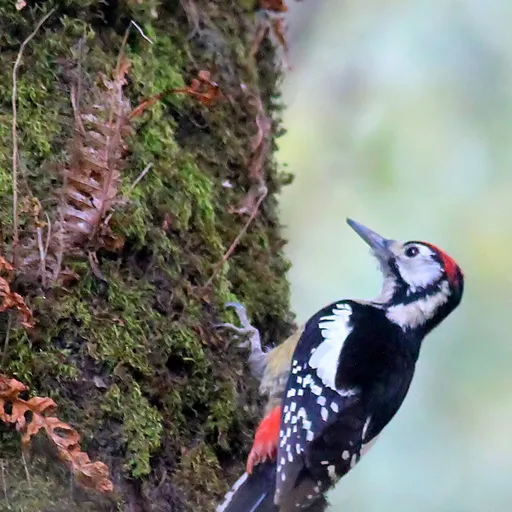
Himalayan Woodpecker
Dendrocopos himalayensis
Least Concern
Overview
The Himalayan woodpecker, Dendrocopos himalayensis, is a medium-sized, pied bird in the family Picidae. It is generally common across the northern Indian subcontinent and is currently assessed as being of least concern by the IUCN.
Identification
- A medium-sized bird approximately 24 cm long with glossy black upperparts and broad white patches from shoulder to lower back.
- Plain white or pale buff underparts and head, distinguished by a black Y-shaped mark on the neck and cheeks, as well as unique black marks under the eyes.
- Males possess a red crown while females have a black crown; the vent and under-tail coverts are red or pink.
- Juveniles appear duller with greyish-black upperparts and less vivid under-tail areas.
Habitat
Native to the northern regions of the Indian subcontinent, including the Himalayas and adjoining areas in Afghanistan, India, Nepal, Bhutan and Pakistan. It inhabits wet or dry upland forests, featuring either deciduous or coniferous trees, often with rhododendrons, at altitudes between 1,500 and 3,200 m.
Diet
The species forages individually, typically on trunks and large branches but occasionally on the ground. It consumes a varied diet of insects, fruits, seeds and sap, sometimes hammering fir cones on stones to extract the seeds.
Did you know?
This woodpecker will occasionally hammer fir cones on stones to extract the seeds.
Sources
- Wikipedia · CC BY-SA 4.0
- Wikidata · CC0 1.0