
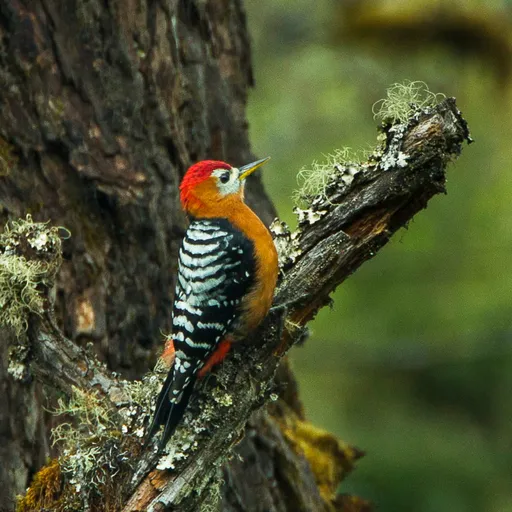
Rufous-bellied Woodpecker
Dendrocopos hyperythrus
Least Concern
Overview
The rufous-bellied woodpecker (Dendrocopos hyperythrus) is a bird in the family Picidae, previously considered an Asiatic sapsucker due to its habit of making small pits in tree bark. It is classified as a species of 'Least Concern' by the IUCN Red List, despite a downward population trend.
Identification
- Length ranges from 19 to 23 cm (7.5 to 9.1 in).
- Males have a red crown, while females have a black crown speckled with white.
- Black mantle and back with wings barred black and white; face is white with uniform cinnamon or rufous throat and underparts.
- Lower belly is black barred with white, and under-tail coverts are red or pink.
- Chestnut iris with a black upper mandible and grey lower mandible; legs are grey or olive.
Habitat
Found along the Himalayas in the Indian subcontinent and Southeast Asia, ranging across Bangladesh, Bhutan, Cambodia, Hong Kong, India, Korea, Myanmar, Nepal, Thailand, Manchuria, Ussuriland and Vietnam. Its natural habitats are subtropical or tropical moist lowland forests and subtropical or tropical moist montane forests.
Diet
It possesses a brushy-tipped tongue that allows it to feed on sap, which is predominantly sought in the spring season. Wood-boring and bark insects are taken at most other times. They utilise trees such as Quercus semecarpifolia, Quercus glauca, Betula utilis, Ilex dipyrena and Rhododendrons.
Did you know?
The sap wells created by these woodpeckers are visited by a variety of other bird species, including rufous sibia, white-browed fulvetta and green-tailed sunbirds.
Sources
- Wikipedia · CC BY-SA 4.0
- Wikidata · CC0 1.0