
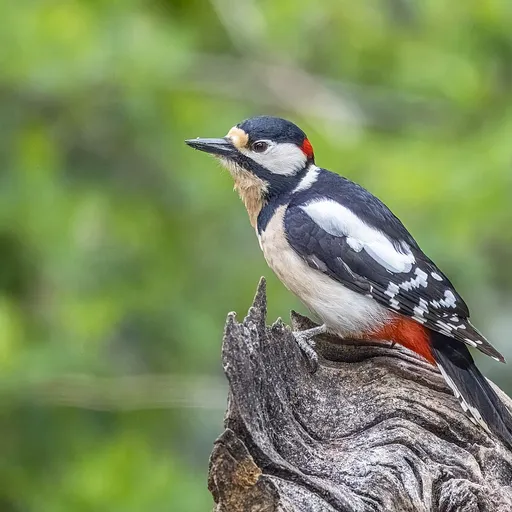
Great Spotted Woodpecker
Dendrocopos major
Least Concern
Listen
XC707121 · Sonothèque ADVL · Carolles, Manche, Normandie, France · CC0 1.0
Overview
The great spotted woodpecker (Dendrocopos major) is a medium-sized bird characterised by pied black and white plumage with a distinctive red patch on the lower belly. It holds the IUCN Red List status of Least Concern and ranges widely across the Palearctic and parts of North Africa.
Identification
- Size and structure: 20–24 cm long with a wingspan of 34–39 cm; features a slate-black bill, greenish-grey legs, and deep red eyes.
- Plumage: Glossy blue-black upperparts with large white shoulder patches and barred flight feathers; white underparts with a scarlet lower belly and undertail.
- Sexual differences: Males possess a crimson patch on the nape, whereas females lack this marking; juvenile birds are less glossy with brown tinges and a pink lower belly.
- Voice: Produces a sharp kik call, a rattling krrarraarr when disturbed, and a gwig courtship call, accompanied by rapid mechanical drumming on trees.
Habitat
Found across Eurasia from Ireland to Japan and in North Africa from Morocco to Tunisia, this species inhabits a wide variety of woodlands, including broadleaf, coniferous, and mixed forests, as well as modified habitats such as parks, gardens, and olive groves. It occurs from sea level to the tree line, reaching altitudes of up to 2,500 m in Central Asia.
Diet
This omnivorous bird extracts insect larvae from inside trees using a chiselling action and a long, bristly tongue, and also consumes beetles, ants, spiders, and Lepidoptera larvae. In the north, fat-rich plant products such as nuts and conifer seeds are vital winter food, sometimes supplying over 30% of its energy requirements. It may also raid the nests of other cavity-nesting birds for eggs and chicks, and feeds on bird seed from feeders.
Did you know?
As late as the early twentieth century, it was believed that the species' distinctive drumming was a form of vocalisation, but in 1943 it was finally proved to be purely mechanical.
Sources
- Wikipedia · CC BY-SA 4.0
- Wikidata · CC0 1.0