
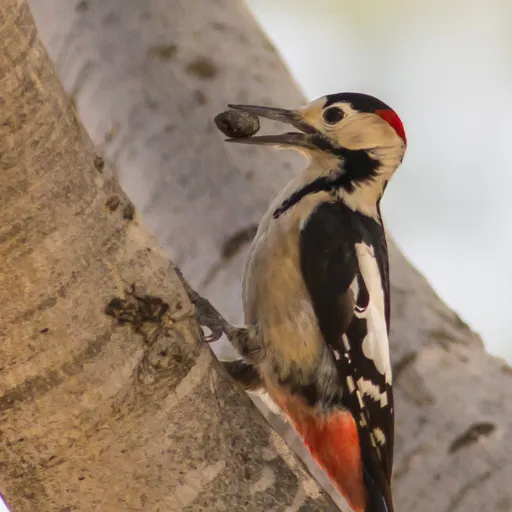
Syrian Woodpecker
Dendrocopos syriacus
Least Concern
Overview
The Syrian woodpecker (Dendrocopos syriacus) is a member of the woodpecker family that was first described in 1833. It is a resident breeding bird that has recently expanded its range further northwest into Europe.
Identification
- Size and plumage: Approximately 23 cm long, the male features glossy black upper parts with a crimson nape spot, white forehead and face, and a large white shoulder patch.
- Tail and bill: The three outer tail feathers have few white spots, the bill is long and slate black, and the legs are greenish grey.
- Vocalisation: The call is a sharp 'quit, quit', described as softer than the great spotted woodpecker and similar to a common redshank.
Habitat
Found from southeastern Europe east to Iran, this species inhabits open woodlands, cultivations with trees, scrublands and parks. It depends heavily on old trees for both food sources and nesting sites.
Diet
The bird primarily consumes insects that bore into timber, such as larvae of wood-boring moths and beetles, as well as bees. It forages by tapping bark and extracting prey from crevices with its sticky tongue, occasionally eating seeds, nuts and berries when insect food is scarce.
Did you know?
In Israel, Syrian woodpeckers attack polyethylene irrigation pipes, pecking rounded holes that reduce water pressure in agricultural plots. The exact motivation for this behaviour remains unclear.
Sources
- Wikipedia · CC BY-SA 4.0
- Wikidata · CC0 1.0