
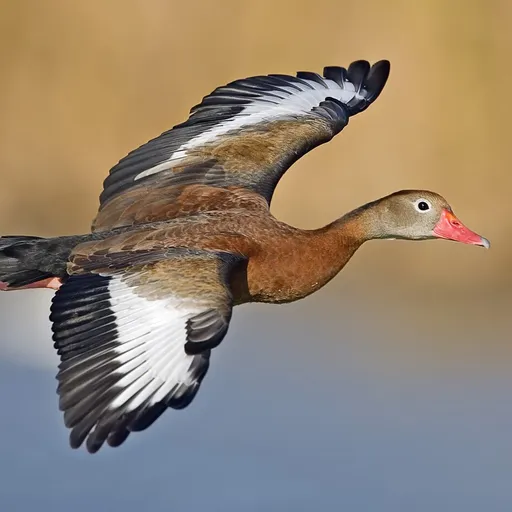
Black-bellied Whistling Duck
Dendrocygna autumnalis
Least Concern
Listen
XC820556 · Rosa Elena Albornoz · Bolívar Park (near Caracas), Sucre, Miranda, Venezuela · CC0 1.0
Overview
The black-bellied whistling duck (Dendrocygna autumnalis), also known as the black-bellied tree duck, is a mid-sized waterfowl found throughout the Americas. It is one of only two whistling duck species native to North America and is classified as a species of least concern by the IUCN.
Identification
- Mid-sized bird (47–56 cm long) with a long pink bill, long head, and longish legs.
- Pale gray head and chestnut-brown plumage on the cap, neck, and back, contrasting with a black belly and tail.
- Extensive white in the wings formed by secondary remiges, with black primaries; distinctive white eye-ring.
- Emits a clear, noisy whistling 'waa-chooo' call.
Habitat
This species inhabits shallow freshwater ponds, lakes, marshes, cultivated land, and reservoirs with plentiful vegetation. Its range spans from the southern United States and Mexico through Central America to South America, though it is generally resident with only local seasonal movements rather than true long-range migration.
Diet
The black-bellied whistling duck feeds mainly on plant material such as seeds, corn, rice, and weeds, but also consumes arthropods, aquatic invertebrates, and tadpoles. Foraging often occurs at night by wading through shallow water or gleaning in recently harvested fields where harvesters have disturbed the soil.
Did you know?
Unlike most ducks, this species forms strong monogamous pair-bonds that often last for many years, a trait more commonly associated with geese and swans, and both parents share all duties in rearing the young.
Sources
- Wikipedia · CC BY-SA 4.0
- Wikidata · CC0 1.0