
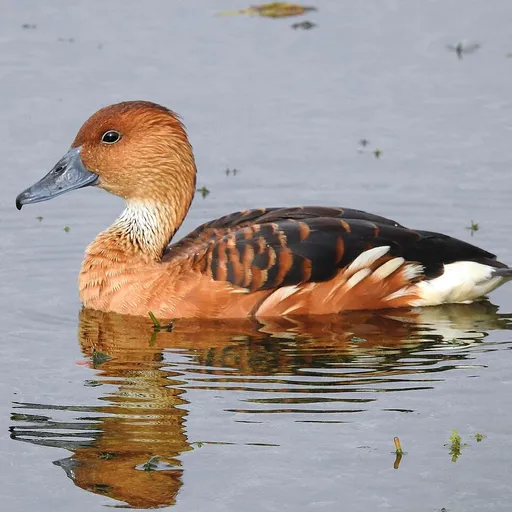
Fulvous Whistling Duck
Dendrocygna bicolor
Least Concern
Overview
The fulvous whistling duck (Dendrocygna bicolor), also known as the fulvous tree duck, is a species of whistling duck that breeds across the world's tropical regions. It has a very large range extending across four continents, including much of Mexico, South America, the West Indies, the southern United States, sub-Saharan Africa and the Indian subcontinent.
Identification
- Plumage is mainly reddish brown (fulvous) with a darker back, whitish stripes on the flanks, and a dark brown to black stripe running from the crown to the base of the mantle.
- In flight, it displays a distinctive white crescent on the rump contrasting with a black tail; wings are brown above and black below.
- It is a long-legged duck with a long grey bill, measuring 45–53 cm in length.
- It produces a clear whistling kee-wee-ooo call, frequently heard on the ground or in flight, including at night.
Habitat
Preferred habitats include lowland marshes, swamps, shallow lakes, rice fields, and other open wetlands with plentiful vegetation, while avoiding wooded areas. The species undertakes seasonal movements in response to the availability of water and food, such as southward movements by African birds in the southern summer and nomadic patterns by Asian populations.
Diet
Feeds in wetlands by day or night on plant material including seeds, bulbs, grasses, and stems. Females preparing for egg-laying may include animal items such as aquatic worms, molluscs, and insects, which can comprise up to 4% of their diet.
Did you know?
The genus name Dendrocygna is derived from the Ancient Greek for 'tree' and Latin for 'swan', reflecting its ancient lineage, although the birds are noted for walking well without waddling and do not often perch in trees.
Sources
- Wikipedia · CC BY-SA 4.0
- Wikidata · CC0 1.0