
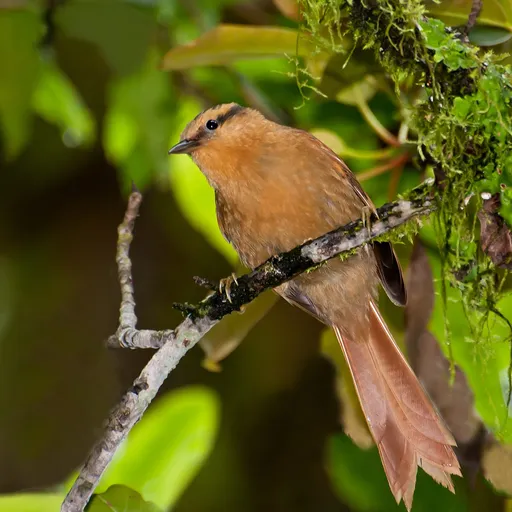
Buff-fronted Foliage-gleaner
Dendroma rufa
Listen
XC863757 · Rosa Elena Albornoz · Fila De Mariches (near Parroquia La Dolorita), Sucre, Distrito Capital, Venezuela · CC0 1.0
Overview
The buff-fronted foliage-gleaner (Dendroma rufa) is a largish furnariid bird native to the Neotropical realm. It belongs to the Furnariinae subfamily of the ovenbird family Furnariidae and is recognised as a species across three major taxonomic systems.
Identification
- Size and Build: A large furnariid, measuring 18 to 19 cm in length and weighing 25 to 36 g.
- Plumage: Features an ochraceous forehead extending into a wide supercilium, dull brownish gray upperparts, and bright rufous wings with darker primary coverts.
- Underparts: Glowing ochraceous throat and breast fading to a duller ochraceous belly and flanks.
- Song: Emits a fast, accelerating series of staccato, metallic notes described as 'whi-ki-ki-ki-ke-ke-ke-kuh-kuh', or a squeaky 'woika-woika-woika...' in Costa Rica.
Habitat
This species has a highly disjunct distribution across Central and South America, inhabiting humid foothill and montane forests in the northern and western regions and tropical lowland evergreen or gallery forests in the southeast. Elevations range from near sea level in the southeast to 2,500 m in Central America. It is a year-round resident throughout its range.
Diet
The bird feeds on a wide variety of adult and larval arthropods, foraging mostly in the subcanopy and canopy along horizontal branches. It typically forages singly, in pairs, or in mixed-species flocks, acrobatically gleaning prey from live leaves, dead leaves, bark, moss, and debris, often hanging nearly upside down to reach undersides.
Did you know?
Nests are situated in existing holes within earthen banks, trees, or even walls, lined with fine grass, rather than being excavated by the birds. The species is considered uncommon to rare in most of its range, partly because its tree-top lifestyle makes it difficult to observe, though it is fairly common in the southeast.