
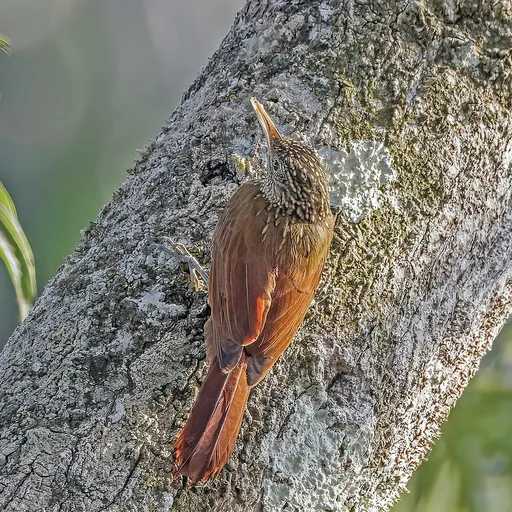
Straight-billed Woodcreeper
Dendroplex picus
Least Concern
Listen
XC590784 · Nelson Hernández · Jordán, Jordán, Santander, Colombia · CC BY 4.0
Overview
The straight-billed woodcreeper (Dendroplex picus) is a slim, medium-sized bird in the ovenbird family Furnariidae. It is classified as Least Concern by the IUCN due to its extremely large range and estimated population of at least five million mature individuals.
Identification
- Length of 18 to 22 cm with a distinctive bill featuring a straight culmen and an upward-curving mandible.
- Plumage varies by subspecies but typically includes a dark brown to blackish crown with buffy white streaks, a rufous-chestnut rump, and scaly dark markings on the buffy white throat that extend to the upper breast.
- Legs are highly variable in colour, ranging from green to gray and brownish, while the bill is light grayish horn or brownish.
- Song consists of a rapid series of high-frequency notes, often described as 'chip, chip, chip, dip-dip-dii-dii-di-di-di-di-di-di, dew, dew, dew'.
Habitat
Found in Panama, Trinidad, and most mainland South American countries, this species inhabits a wide variety of lowland environments, most of which are open to semi-open rather than densely forested. It utilises forest edges, open woodlands, wooded savannas, secondary forests, and human-altered environments such as plantations. Its elevation range is generally below 600 m, though it reaches higher altitudes in parts of Venezuela, Colombia, and Peru.
Diet
The diet consists mainly of arthropods, but also includes other invertebrates like snails and small vertebrates such as lizards. It typically forages singly by hitching up trunks and branches, gleaning prey from bark and crevices, though it occasionally probes dead wood or joins mixed-species feeding flocks.
Did you know?
This species is a widespread habitat generalist that shows comparatively low sensitivity to human disturbance, preferring open country, second growth, and edges. It has even been observed nesting in artificial structures such as fence posts and nest boxes.
Sources
- Wikipedia · CC BY-SA 4.0
- Wikidata · CC0 1.0