
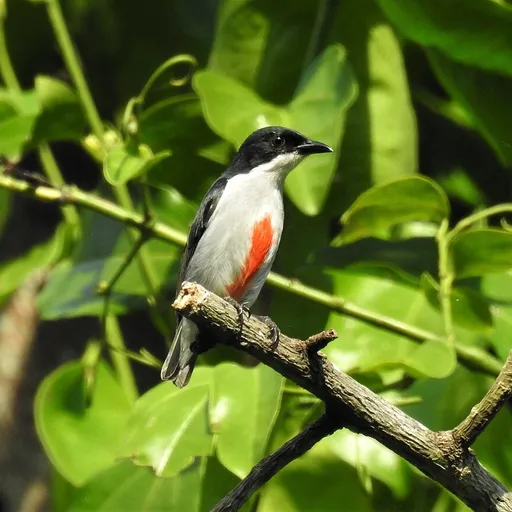
Red-keeled Flowerpecker
Dicaeum australe
Least Concern
Overview
The red-keeled flowerpecker (Dicaeum australe), also known as the red-striped flowerpecker, is a small bird endemic to the Philippines and a member of the family Dicaeidae. It is classified as Least Concern on the IUCN Red List due to its wide range and adaptability to various environments.
Identification
- Males feature glossy blue-black upperparts, a white chin and throat sides, and grey underparts marked by a diagnostic narrow scarlet stripe down the center of the breast and belly.
- Femiles resemble males but are paler, while immature birds are dark greyish-brown above and brownish olive-grey below.
- The bill is small, relatively long, curved, of medium thickness, and black, as are the legs and eye color (dark chestnut).
- Underwing coverts and pectoral tufts are white.
Habitat
Endemic to the Philippines, this species is extremely adaptable and found in lowland forests, second growth, agricultural areas, and parks, but is absent from montane forests. It thrives in degraded habitats, making it one of the few Philippine endemics with a stable population.
Diet
The bird feeds on small fruits, mistletoes, flowers, and small insects, foraging primarily in the canopy and middle stratum of vegetation. It is often found singly, in pairs, or in mixed-species flocks with other flowerpeckers and small birds.
Did you know?
Relative to how common this species is, not much is actually known about its biology, with breeding observed only from April to August.
Sources
- Wikipedia · CC BY-SA 4.0
- Wikidata · CC0 1.0