
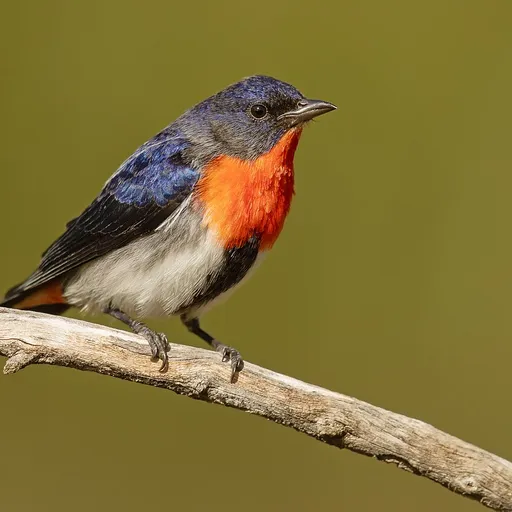
Mistletoebird
Dicaeum hirundinaceum
Least Concern
Overview
The mistletoebird (Dicaeum hirundinaceum), also known as the mistletoe flowerpecker, is a small species of flowerpecker native to most of Australia and the eastern Maluku Islands of Indonesia. As a geologically recent arrival to the Australian continent, it is a specialist frugivore that primarily feeds on the berries of parasitic mistletoes.
Identification
- Males feature a glossy blue-black back with a red chest and a black centre stripe running down a white belly; females are dark grey above with a white throat and light grey underparts.
- A tiny bird measuring 9–10 cm in length, with a small, slender, slightly down-curved bill and black legs.
- Flight is swift and occurs high in the tree canopy, displaying distinctively long and pointed wings.
- Vocalizations include a short, sharp, high-pitched tzew or dzee whistled on the wing, and a repeated whistled wissweet wissweet while perched.
Habitat
Found in forests and woodlands dominated by Eucalyptus species, ranging from the dry interior to coastal rain forests, though absent from Tasmania and the driest desert areas. The species prefers mature stands where larger trees are more likely to be infested with mistletoe and does not frequent high-altitude areas during winter. It exhibits a nomadic lifestyle, with local movements associated with the fruiting of mistletoe.
Diet
The mistletoebird is a specialist frugivore that consumes the berries of mistletoe, which accounts for 85% of its foraging observations, alongside arthropods, nectar, and other berries. It possesses a small muscular stomach and a short alimentary canal that minimise mechanical grinding, allowing mistletoe seeds to pass through its digestive system in as little as four minutes.
Did you know?
The bird's specific epithet, hirundinaceum, is derived from the name of the swallow (Hirundo), referring to its long and pointed swallow-like wings.
Sources
- Wikipedia · CC BY-SA 4.0
- Wikidata · CC0 1.0