
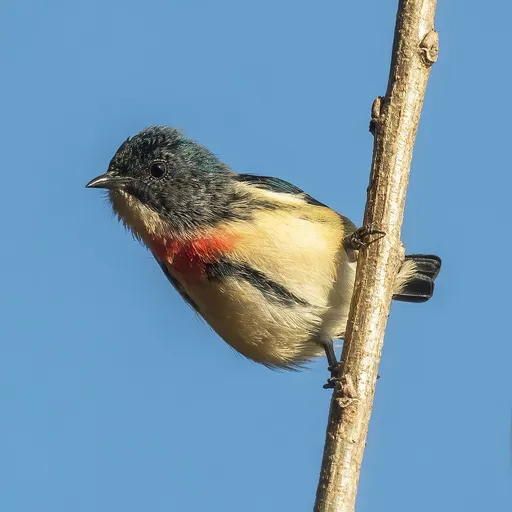
Fire-breasted Flowerpecker
Dicaeum ignipectus
Least Concern
Overview
The fire-breasted flowerpecker (Dicaeum ignipectus) is a tiny bird in the family Dicaeidae found across the Indian subcontinent and Southeast Asia. It plays an important role in the dispersal of fruiting plants and is currently assessed as Least Concern by the IUCN Red List.
Identification
- Males feature glossy blue-black upperparts with a bright red or orange breast patch and a short black stripe on the belly, while females are dull olive above and buff below with a pale-based bill.
- The bird is exceptionally small, weighing just 7–9 g and measuring under 7 cm in length, making it one of the smallest flowerpeckers.
- It produces a shrill call given regularly that has been likened to snipping scissors or a staccato 'tsit'.
Habitat
Found widely in the sub-Himalayan regions of India, Nepal, Bhutan, and Bangladesh, extending into Southeast Asia including Indonesia, Laos, Thailand, Vietnam, Taiwan, Malaysia, and the Philippines. Its natural habitats include temperate forests, subtropical or tropical moist lowland and montane forests, typically situated above 1,000 metres, though in China they may be found at lower altitudes during winter.
Diet
Like other flowerpeckers, this species feeds on fruits and is a significant disperser of mistletoe seeds, including Scurrula species in the Nepal Himalayas. They are usually found at the tops of trees, especially on mistletoes, and often keep themselves well out of sight.
Did you know?
Described by B. H. Hodgson as 'the smallest bird of India', an adult specimen is hardly two and a half inches in total length and weighs only three and a half drachms. The species was first described by Edward Blyth in 1843, but the type specimen claimed to be at the British Museum is said to be lost.
Sources
- Wikipedia · CC BY-SA 4.0
- Wikidata · CC0 1.0