
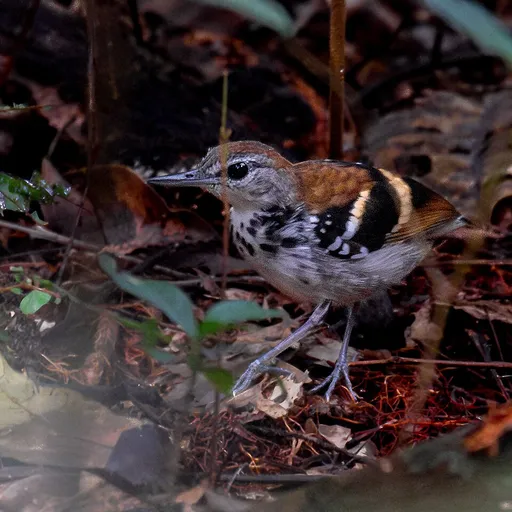
Banded Antbird
Dichrozona cincta
Least Concern
Listen
XC249107 · Niels Krabbe · Orellana: 'Maxus' road km 37 (27 km SSE Pompeya), Ecuador · CC BY-SA 4.0
Overview
The banded antbird (Dichrozona cincta), sometimes called the banded antwren despite not being close to true antwrens, is a species of bird in the family Thamnophilidae. It is the only member of the genus Dichrozona and is assessed as Least Concern by the IUCN.
Identification
- Adults of the nominate subspecies feature a grayish face with a thin white supercilium and a blackish eye-line, while females have fewer spots and a buff band on the lower back.
- The crown, nape, and upper back are cinnamon-brown with a white patch between the scapulars, contrasting with lower back, rump, and uppertail coverts banded in black, white, and gray.
- Underparts are white with a band of black spots across the breast and brownish-gray flanks, in birds measuring 9 to 10 cm in length.
- The song consists of a slow, gradually rising series of 15–20 drawn-out, loud, sharp 'tueét' notes, accompanied by calls like a short whistle or a rattle.
Habitat
The species inhabits evergreen forest, primarily terra firme away from waterways, favouring areas with an open understorey and much leaf litter. Its range extends across Bolivia, Brazil, Colombia, Ecuador, Peru, and Venezuela, generally up to 800 m above sea level.
Diet
The banded antbird forages almost entirely while walking on the ground, probing and flipping leaf litter, and also reaches or jumps to glean from leaves and stems. It mostly forages singly or in pairs without joining mixed-species feeding flocks, and its diet is thought to consist of arthropods.
Did you know?
Despite often being referred to as the banded antwren, the bird is not closely related to true antwrens. It is also the sole member of its genus, Dichrozona.
Sources
- Wikipedia · CC BY-SA 4.0
- Wikidata · CC0 1.0