
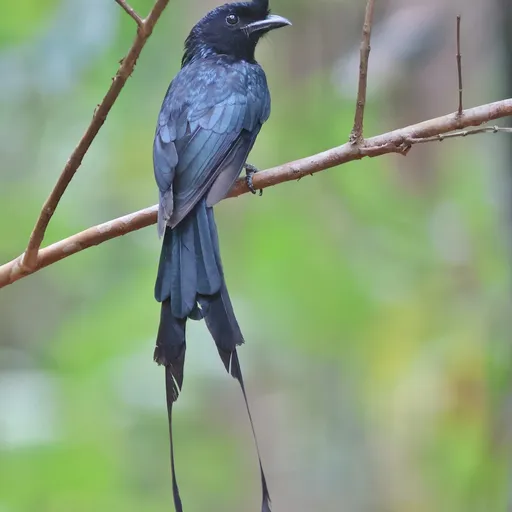
Greater Racket-tailed Drongo
Dicrurus paradiseus
Least Concern
Listen
XC976304 · Christoporus Merung · Rungan, Gunung MAS Regency, Central Kalimantan, Indonesia · CC0 1.0
Overview
The greater racket-tailed drongo (Dicrurus paradiseus) is a medium-sized Asian bird that is the largest of the drongo species in most of its range. It is easily recognised by its elongated outer tail feathers with webbing restricted to the tips and a distinctive crest of curled feathers. This widespread species is classified as Least Concern on the IUCN Red List.
Identification
- The bird features a prominent crest of curled feathers running from above the beak along the crown, alongside a tail with twisted rackets that can appear like two large bees chasing a black bird in flight.
- Young birds are duller and may lack the crest, while moulting individuals can be missing their elongate tail streamers.
- The voice is extremely varied, including monotonous whistles, metallic sounds, and complex imitations of other birds, often starting as early as 4 am with a metallic 'tunk-tunk-tunk' series.
Habitat
This species inhabits forest environments where it is often conspicuous, perching in exposed locations. Its distribution extends from the western Himalayas to the eastern Himalayas and Mishmi Hills at elevations below 1,200 m, continuing through peninsular India, the Western Ghats, and east to the islands of Borneo and Java.
Diet
Primarily an insectivore, the greater racket-tailed drongo also consumes fruit and visits flowering trees for nectar. It often forages in mixed-species flocks, where it may engage in kleptoparasitism by stealing prey caught or disturbed by other foragers.
Did you know?
This drongo is one of the few birds known to use vocal mimicry context-sensitively, imitating the alarm calls of other species to alert them and then stealing prey from the ensuing panic, a behaviour analogous to humans learning useful exclamations in foreign languages.
Sources
- Wikipedia · CC BY-SA 4.0
- Wikidata · CC0 1.0