
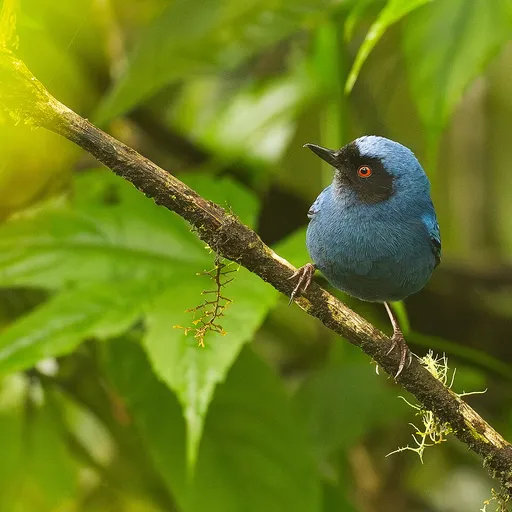
Masked Flowerpiercer
Diglossa cyanea
Least Concern
Listen
XC250776 · Niels Krabbe · Zamora-Chinchipe: above Río Blanco, Ecuador · CC BY-SA 4.0
Overview
The masked flowerpiercer is a species of bird in the tanager family, Thraupidae, classified as Least Concern on the IUCN Red List. It is endemic to the Andes in South America, where it inhabits humid montane environments.
Identification
- Adults grow to a length of about 15 cm (6 in).
- The adult male is deep ultramarine blue with a dark mask, while the female is similar but duller.
- Features a large, black, upturned beak with a characteristic hook on the tip of the upper mandible and a bright red iris in adults.
- Song varies by region, consisting of reedlike notes terminating in a twitter in the north and a jangling series of high-pitched notes ending with lengthy 'tseee' notes in the south.
Habitat
Found in humid montane forest, cloud forest, secondary forest, scrubby woodland and forest edges in Venezuela, Colombia, Ecuador, Peru and Bolivia. It lives at altitudes between approximately 2,000 and 3,500 m (6,600 and 11,500 ft).
Diet
Forages through foliage for insects and fruit, and probes into flowers to access nectar using a sharp hook on the upper mandible. It also consumes stamens, sometimes pulling them off flowers such as those of Axinaea sclerophylla one at a time.
Did you know?
The differing songs of northern and southern populations suggest that these groups may actually be different species. Flowerpiercers got their name from the fact that they use a sharp hook on the tip of their upper mandible to slice open the base of flowers.
Sources
- Wikipedia · CC BY-SA 4.0
- Wikidata · CC0 1.0