
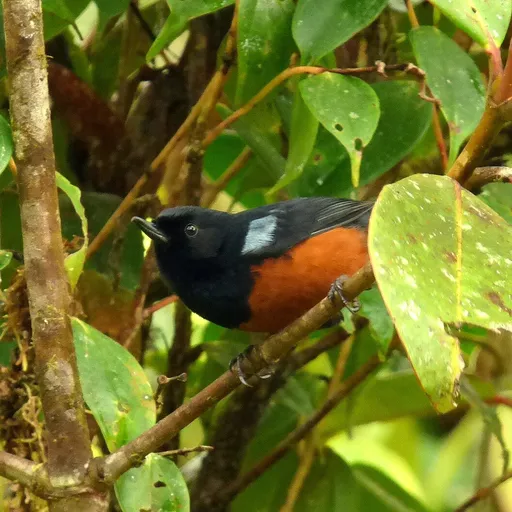
Chestnut-bellied Flowerpiercer
Diglossa gloriosissima
Near Threatened
Overview
The chestnut-bellied flowerpiercer (Diglossa gloriosissima) is a species of montane tanager endemic to the highlands of Colombia. It is classified as Near Threatened by the IUCN, though the Colombian Red Book considers it Vulnerable due to its severely fragmented distribution and small population size.
Identification
- Small bird measuring 14–15 cm in length with a slender, upturned bill.
- Adult males feature deep glossy black heads, upper breasts, backs, wings, and tails, contrasted with deep rufous-chestnut lower breasts, bellies, and vents that have black markings on the flanks.
- Juveniles resemble adults but possess duller black plumage, chestnut areas streaked with black, and a lower mandible that is yellow with a dark tip.
Habitat
Found at elevations between 3000 and 3800 m in the Western Andes of Colombia, with one population extending down to 2400 m. Typical habitats include open páramo, shrubby sub-páramo, and the edges of elfin forest, where the species favours Polylepis woodlands and small trees such as Escallonia and Baccharis.
Diet
This species pierces flowers at the base to extract nectar, primarily feeding on Melastomataceae and Ericaceae plants such as Cavendishia, Psammisia, and Thibaudia, as well as Loranthaceae and epiphytic bromeliads. It also forages for small insects and has been observed visiting hummingbird feeders.
Did you know?
The species epithet gloriosissima derives from the Latin for 'most glorious', a name Chapman likely chose because the bird is much larger than the similar Mérida flowerpiercer (Diglossa gloriosa) with which he compared his original specimens.
Sources
- Wikipedia · CC BY-SA 4.0
- Wikidata · CC0 1.0