
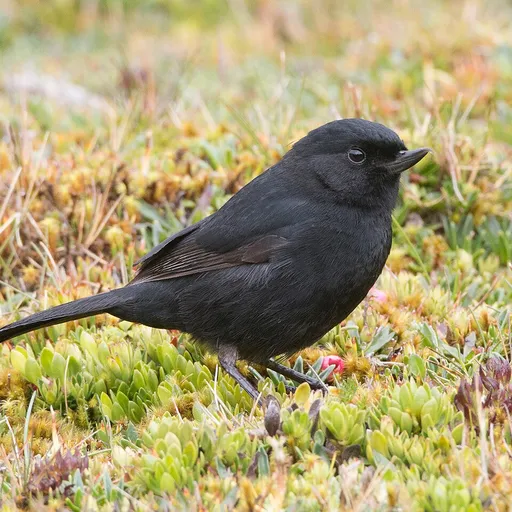
Black Flowerpiercer
Diglossa humeralis
Least Concern
Listen
XC242554 · Niels Krabbe · Azuay: 5.5 km SW Molleturo, Ecuador · CC BY-SA 4.0
Overview
The black flowerpiercer (Diglossa humeralis) is a species of bird in the family Thraupidae. It is distributed across parts of South America, including Colombia, Ecuador, Peru, and Venezuela.
Identification
- Adults are 13–14 cm in length and appear uniformly black, with males exhibiting a subtle blue gloss and females having brownish wings and tails.
- The bill is black with a grey base, and the eyes are brown.
- The song consists of a rapid series of squeaky trills and twitters, faster than that of the glossy flowerpiercer and resembling the cinereous conebill.
Habitat
This species inhabits subtropical or tropical moist mountains, high-altitude shrubland, and degraded former forests, typically between 2,175 and 4,000 metres elevation, though mostly found between 2,700 and 3,400 metres. It is frequently observed at the edges of dense wet forests, in scattered vegetation, shrubby clearings, eucalyptus plantations, parks, and gardens.
Diet
The black flowerpiercer drinks nectar and consumes small invertebrates. It moves quickly through its environment and is more active in the lower parts of the forest, typically remaining solitary or found in pairs.
Did you know?
Although its natural range is restricted to South America, the species has now been seen in Bangalore, India.
Sources
- Wikipedia · CC BY-SA 4.0
- Wikidata · CC0 1.0