
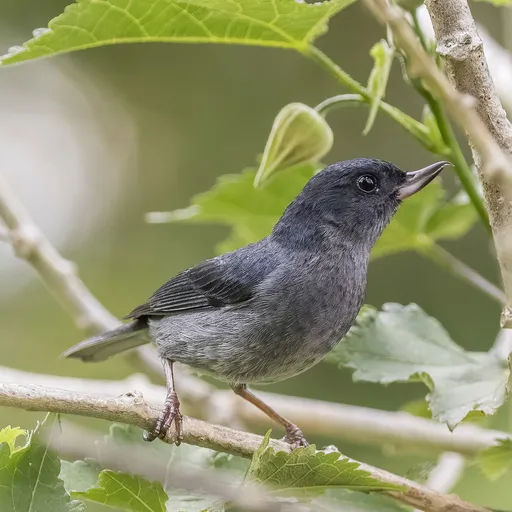
Slaty Flowerpiercer
Diglossa plumbea
Least Concern
Overview
The slaty flowerpiercer (Diglossa plumbea) is a small passerine bird endemic to the Talamancan montane forests. It is classified as Least Concern on the IUCN Red List.
Identification
- Males display blue-grey plumage with a lead-grey throat and breast, while females are olive-brown above with a paler underparts shading to buff.
- The bird measures 10 cm in length and weighs 9 g, featuring an upturned bill with a hooked upper mandible and a pointed lower mandible.
- Young birds resemble females but possess two tawny wing bars and faintly streaked buff-yellow underparts.
- The call is a thin tsip, whereas the male's song consists of whistles, warbles, and trilled notes described as 'see-chew see-chew see-chew seer seer surrzeep, tsee tsew tsink tsink tsink'.
Habitat
This species inhabits mountain forest canopies and edges, particularly sunlit clearings and areas with flowering shrubs, which can extend to gardens. It breeds between 1200 m and 1900 m depending on location and can be found well above the timberline in páramo habitat.
Diet
The slaty flowerpiercer pierces the base of flowers with its bill to extract nectar using a brush-like tongue, a behaviour that often results in attacks from territorial hummingbirds. It also consumes tiny insects taken from foliage or in flight.
Did you know?
The female constructs a large cup nest made of coarse plant material and fine fibres, which she places between 0.4 and 4 m up in dense shrubs, grass tussocks, or pines.
Sources
- Wikipedia · CC BY-SA 4.0
- Wikidata · CC0 1.0