
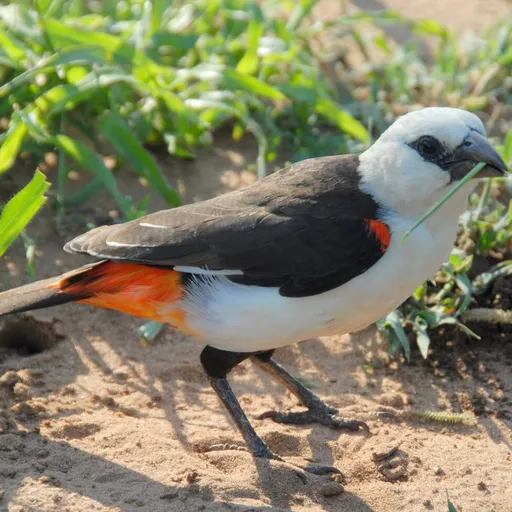
White-headed Buffalo Weaver
Dinemellia dinemelli
Least Concern
Overview
The white-headed buffalo weaver (Dinemellia dinemelli) is a passerine bird in the family Ploceidae native to East Africa. It is currently classified as Least Concern on the IUCN Red List. The species derives its common name from its habit of following African buffalo to feed on disturbed insects.
Identification
- Plumage: Features a white head and underparts, contrasting with a vividly orange-red rump and undertail coverts; thighs are dark brown, and narrow white bands are visible on the wings, especially when stretched.
- Size: Measures 170 to 190 mm in length and weighs between 57 and 85 g.
- Bill: Conical and black.
- Subspecies differences: D. d. dinemelli has a brown tail, whereas D. d. boehmi has a black tail; both sexes are similar in plumage.
- Song: Calls include parrot-like sounds such as "skwieeer" and "kiiyerr", a ringing "tew", slow trills like "tsu-weely-weely-wair", and various chuckles and whistles.
Habitat
Native to Ethiopia, Kenya, Somalia, Sudan, Tanzania, and Uganda, the bird prefers habitats such as savanna and shrublands, with a particular preference for dry brush and acacia thickets.
Diet
This gregarious bird forages on the ground for insects, especially beetles and butterflies, as well as fruits and seeds. It typically forages in groups of three to six birds, often in company with starlings.
Did you know?
Males display to females by spreading their wings to show off white wing-patches and red-orange tail-coverts. Nests are constructed by pushing materials together rather than interweaving them, often incorporating defensive thorny branches and reaching 2 to 4 metres above the ground.
Sources
- Wikipedia · CC BY-SA 4.0
- Wikidata · CC0 1.0