
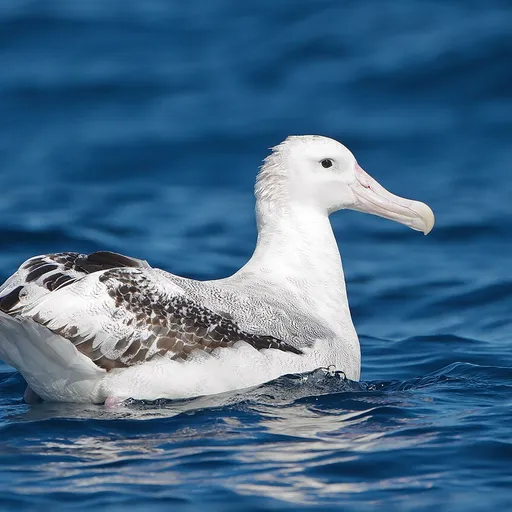
Snowy Albatross
Diomedea exulans
Vulnerable
Overview
The snowy albatross, also known as the wandering albatross, is the largest species of albatross and holds the record for the greatest known wingspan of any living bird. It is listed as Vulnerable on the IUCN Red List and is one of the two largest members of the genus Diomedea.
Identification
- Plumage: Adults have white bodies with black and white wings; males possess whiter wings with only black tips and trailing edges, while juveniles start as chocolate brown and become whiter with age.
- Size: Exhibits the longest wingspan of any living bird, reaching up to 3.7 m, with a body length of 107 to 135 cm.
- Bill and Legs: Features a large pink bill and pink feet.
- Markings: Often displays a pink-yellow stain on the neck caused by the excretion of high saline solution through a salt gland above the nasal passage.
Habitat
This seabird has a circumpolar range in the Southern Ocean, breeding on isolated island groups such as South Georgia, the Crozet Islands, and the Kerguelen Islands. It ranges from 28° to 60° south latitude, spending most of its life in flight and landing primarily to breed or feed.
Diet
Snowy albatrosses feed at the surface during daylight hours, mainly on cephalopods, small fish, and crustaceans. They are often attracted to fishing vessels, where they forage on bait, caught fish, and offal.
Did you know?
The species is capable of remaining in the air without flapping its wings for several hours at a time, travelling 22 m for every metre of drop. Some individuals are known to circumnavigate the Southern Ocean three times in a single year, covering more than 120,000 km.
Sources
- Wikipedia · CC BY-SA 4.0
- Wikidata · CC0 1.0