
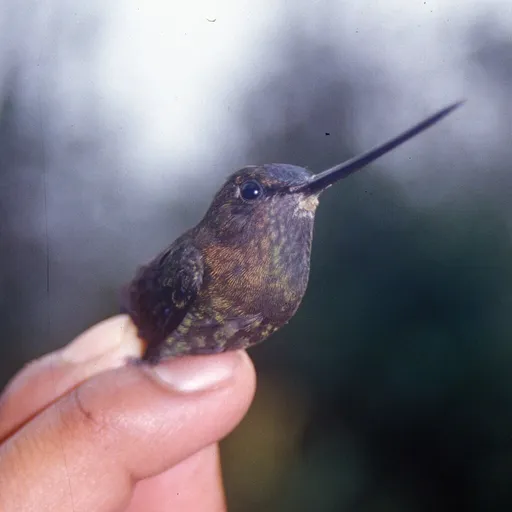
Green-fronted Lancebill
Doryfera ludovicae
Least Concern
Listen
XC250793 · Niels Krabbe · Zamora-Chinchipe: above 'Cabañas Yankuam' 2 km S Las Orchideas, Nangaritza Valley, Ecuador · CC BY-SA 4.0
Overview
The green-fronted lancebill, Doryfera ludovicae, is a species of hummingbird in the family Trochilidae known for its exceptionally long bill and distinctive plumage. It is classified as Least Concern on the IUCN Red List, with stable populations estimated at over 10,000 mature individuals.
Identification
- A prominent, glittering green patch of feathers on the forehead, though female appearance can vary from barely visible to matching male plumage.
- A drab grey-green breast and belly, with a coppery patch extending from the nape down the sides of the neck.
- Rich green on the crown, back, and upper tail that iridesces to teal and turquoise depending on the light.
- An exceptionally long, slightly upturned bill ranging from 29 mm to 36.5 mm in length, which inspired the genus name Doryfera.
Habitat
Found in subtropical and tropical moist montane forests, specifically in Talamancan montane forests, the Serranía del Darién, and the northern Andes. The species is non-migratory and concentrates around highly developed forest locations adjacent to fast-moving streams and rivers.
Diet
Feeds on the nectar of epiphytes, including mistletoe, using its long, slightly upturned bill to access flowers with long, curved corollas. Its bill shape allows for specific floral partnerships, though it does not rely on a single plant species.
Did you know?
The nest is built exclusively by the female and is attached to the side of vertical overhangs, such as cliff faces, using spider web as an adhesive anchor to bind moss and lichen to the rock or soil.
Sources
- Wikipedia · CC BY-SA 4.0
- Wikidata · CC0 1.0