
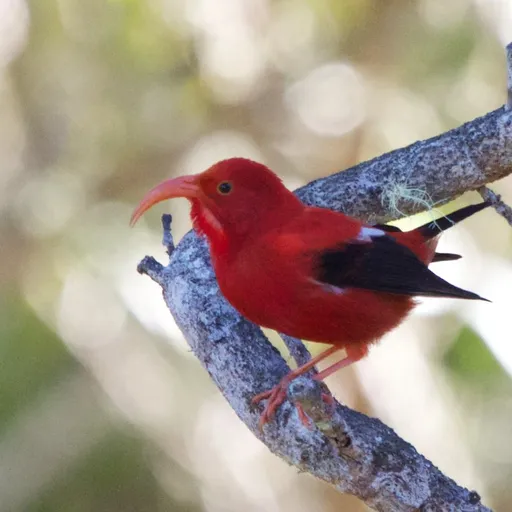
Iiwi
Drepanis coccinea
Vulnerable
Overview
The ʻiʻiwi (Drepanis coccinea), also known as the scarlet honeycreeper, is a species of Hawaiian honeycreeper that serves as a highly recognizable symbol of the islands. Classified as Vulnerable on the IUCN Red List, this species has lost over 90% of its historical range and is currently threatened by avian malaria and habitat loss.
Identification
- Adult plumage is predominantly scarlet with contrasting black wings and tail, making the bird easily visible against green foliage.
- Possesses a long, decurved, salmon-colored bill specialized for extracting nectar from flowers.
- Song is complex and varied, resembling the sound of whistles, balls dropping in water, the rubbing of balloons, or a squeaking hinge.
- Young birds feature golden plumage with spots and ivory bills, which were historically mistaken for a different species.
Habitat
The species primarily inhabits mesic to wet forests at higher elevations between 4,265 and 6,234 feet, with the largest populations on Hawaiʻi Island and East Maui. Ninety percent of the population is confined to a narrow forest band on these islands, while numbers on Kauaʻi, Molokaʻi, and Oʻahu are minimal, and the bird is no longer present on Lānaʻi.
Diet
The ʻiʻiwi uses its long, curved bill to extract nectar from the decurved corollas of ʻōhiʻa lehua and, historically, Hawaiian lobelioids. It also consumes small arthropods as part of its diet.
Did you know?
The bird is an altitudinal migrant that follows the progress of flowering ʻōhiʻa plants to higher elevations, a movement pattern that exposes them to mosquito-borne avian malaria at lower levels. With more than 75% of exposed birds contracting the disease and a 90% overall mortality rate following a single mosquito bite, the ʻiʻiwi is one of the most susceptible Hawaiian honeycreepers.
Sources
- Wikipedia · CC BY-SA 4.0
- Wikidata · CC0 1.0