
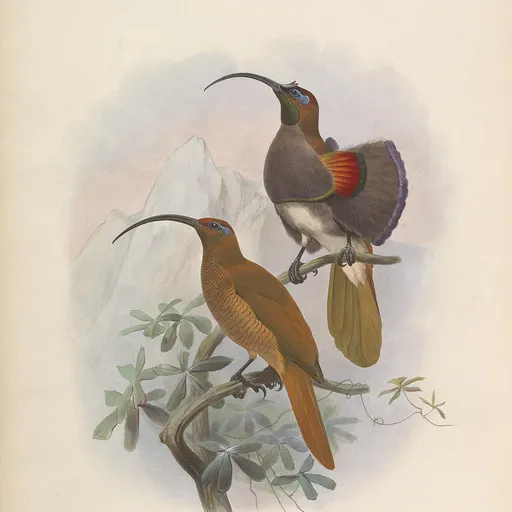
Black-billed Sicklebill
Drepanornis albertisi
Least Concern
Overview
The black-billed sicklebill, also known as the buff-tailed sicklebill, is a medium-sized bird-of-paradise and one of the only two members of the genus Drepanornis. It is currently listed as Least Concern on the IUCN Red List, though it appears on Appendix II of CITES.
Identification
- Medium-sized at approximately 35 cm, with predominantly brown plumage.
- Males possess a black, sickle-shaped bill, bare maroon-grey skin around the eye, and a buff-coloured tail.
- Males are adorned with dark, horn-like forecrown feathers, an erectile bronze neck plume fan, and elongated purple-tipped flank plumes.
- Females are smaller and unadorned, with a bill longer than that of males and dark barbing underneath.
Habitat
Found in tropical montane forests across western, central and eastern New Guinea, typically at altitudes between 1100 and 1900 m above sea level. Its presence is scattered within these mountainous regions.
Diet
The diet consists mainly of fruit and arthropods. Females lay one to two pale cream eggs with brown and grey spots.
Did you know?
The species name honours Luigi Maria d'Albertis, the Italian naturalist who discovered the bird in 1872, while its generic name Drepanornis literally translates to 'sickle bird' in reference to its distinctive beak shape.
Sources
- Wikipedia · CC BY-SA 4.0
- Wikidata · CC0 1.0