
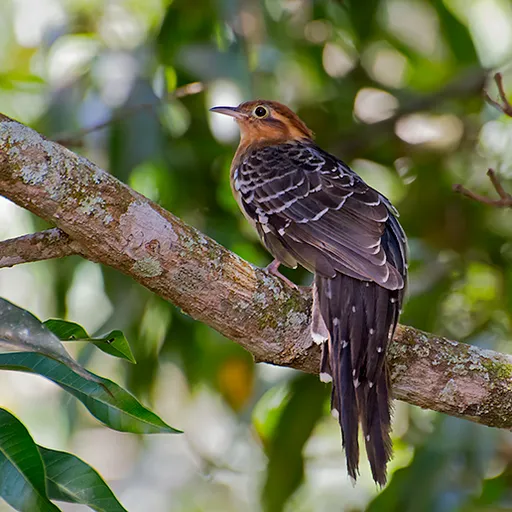
Pavonine Cuckoo
Dromococcyx pavoninus
Least Concern
Overview
The pavonine cuckoo (Dromococcyx pavoninus) is a Neotropical cuckoo distinguished by its long, graduated tail and short crest. It is one of only three Neotropical cuckoo species known to practice brood parasitism, a rare strategy within the Amazon basin.
Identification
- Head and crest are rusty brown, with the rest of the plumage being dark brown above and rich buff on the supercilium, throat, and breast.
- The throat and breast lack the dark spots or streaks found in the similar pheasant cuckoo, and the buff colouration is richer.
- It possesses a long, graduated tail and is larger in overall size than the pheasant cuckoo.
- In flight, it has a curious appearance resembling the flapping wings of a butterfly, with slow, measured wingbeats and a brief pause at the top of the stroke.
Habitat
Inhabits the understorey of subtropical or tropical moist lowland and montane forests across South America. Its range extends from Venezuela and Colombia south through Brazil, Bolivia, Paraguay, and Argentina, as well as in Peru, Ecuador, Guyana, and French Guiana. The species has a wide range but a patchy distribution, being absent from some areas where it might be expected.
Diet
Its diet is poorly understood but consists mainly of insects, with orthoptera forming a significant portion. It forages primarily on the ground or within the forest understorey.
Did you know?
As a brood parasite, the female lays a single egg in the nest of a host species, and the hatchling kills any host chicks or removes their eggs. Surprisingly, unlike other cuckoos, its eggs do not closely resemble those of the host species.
Sources
- Wikipedia · CC BY-SA 4.0
- Wikidata · CC0 1.0